- cross-posted to:
- 3dprinting@lemmy.world
- cross-posted to:
- 3dprinting@lemmy.world
You must log in or register to comment.
Great… can’t wait for politicians to use this as a way to pass “common sense” legislation banning 3D printers.
Aren’t they already doing that due to their hysteria over “ghost” guns?
I learned from Mario that ghosts can only harm you if you look away. They never had guns, but I guess the same applies for that.
I thought Luigi was the one with ghost gun
Luigi was with me and he didn’t have a gun
Trying to yes. I think it’s model legislation, probably ALEC bs, if I recall CA tried to pass it and hasn’t yet. Maybe a year back.
Washington State’s bill would ban offline 3d printing and essentially force all printers to include DRM to stop undesirable printing.
Well, that’s the excuse at least. The law would have to effectively kill 3D printing. Is that the goal? Idk.
It would severally hurt small time manufacturers, so yeah, probably.
The kind that can be better made with $20 and a trip to home depot?
But what about real guns?
Oh, those ate okay.
They can try, but the parts that make up a printer are used in tons of other applications. It isn’t hard to build one from scratch.
reprap goes brrrr
I wonder how they intend to add DRM to a stepper motor.
Don’t give them any ideas! We don’t need Dumb Restrictions on Motors.
Just by the age verification.
And just like age verification it’s useless because one can build a 3d printer out of an old VCR and a hot glue gun.
They’re already trying that in New York and California, unfortunately. “Any 3D printer capable of printing parts for firearms” was the verbage, from what I recall.
They already are over 3d guns, this will send them ballistic. They want every printer to keep a record of everything they’ve printed. Model legislation, I think CA tried and so far failed to pass it.
3D printers are even less useful here though. The rocket bit can be replaced with a cardboard tube and some balsa fins. The important parts are the active control and circuitry.
But I guess logic doesn’t really enter into the conversation anyway.
You don’t need to ban 3D printers. Restrictions and licensing requirements for making, using, owning rockets and guidance software are enough.
His guidance is just wifi cameras talking to it. Not sure it even is using gps.
To ban stuff like this you have to ban a lot of useful tech
GPS is mentioned.
This already would fall under an FFL for legal citizens anyway. As is the nature of the internet though, this open design will be preserved and available for those who seek it.
Yes. I am actually surprised we haven’t seen a major terrorist attack in a western country using remote controlled or autonomous drones for example. The technology has been available for years now.
3D printed home made guns like the FGC-9 and Urutau have been around for a while now, but remain marginal in gun crime.
As you say, the cat is out the bag and on the internet forever. However homemade guns and instructions on how to make them have been around for decades.
Most western terrorist attacks are by opportunistic losers who don’t have the knowledge or motivation to do something like this.
They’d rather drive a car into people who make them angry and use a gun they already own.
As for organized groups until recently there have been any good reason for an attack from any centrally organized group.
The lack of simple attacks on soft targets is proof that the threat is overstated and that a statistically overwhelming portion of humans simply don’t want to put bombs on busses and rig them to explode on bridges or in tunnels.
There is also survivorship bias. Who knows how many attacks have been prevented that we do not know about.
Ukraine and Russia are western countries. Narco cartels have started using fpv drones, too.
We really should call them northern countries at this point
Being in that category just prevents it from being sold. It’s not illegal federally to build your own weapon without a FFL.
Is that the same rule for destructive devices? Genuinely curious - I know privately made firearms have different rules.
No, for a destructive device you have to file a form 1.
Ah, thanks for the clarification. Granted I live in a state where this is unobtanium officially anyway.
LOL. Like they “ban” some guns?.
Printers are not hard to assemble from parts.
I wonder if there is some archive or torrent for STL files, like an archive of thingiverse or something. Would be nice to archive that just in case.
Is that even necessary? Anyone with a CAD tool can recreate the 3D printed parts from a glance and a few specs.
It’s literally a tube. Which—to be fair—is a “weapon of mass destruction” according to President Bush (the other war criminal president).
Just download the code from github and make a torrent: https://github.com/novatic14/MANPADS-System-Launcher-and-Rocket

Notably absent… the explosives.
But sure, if you are wondering how folks out in Yemen or Gaza managed to retaliate against their oppressors for so long, this is a textbook example of how and why. What’s being proposed is collection of technology we’ve had since at least the 1960s that’s slowly made its way into civilian circulation.
Also…
Khojayev’s just-launched prototype has no effectiveness track record
I mean, we’re seeing what “just-launched prototypes with no effective track record” have accomplished on the Ukraine-Russia front-lines and it’s a decidedly mixed bag.
I think a harder question to answer is “Who would be interested in putting one of these into practical use?” And that gets to the real value-add of a Stinger MANPAD. Namely, the humans willing and practiced enough to use it.
Also - and again, this cannot be overstated - the model above has no explosives installed. Idk how confident I’d be around one of these things if it was actually armed.
It’s not a MANPAD really.
The sensor package has no IR sensor (or radar unit) and no way to proximity fuse.
It has GPS, accelerometer and barometric pressure. It’s more like a rocket powered artillery shell than an anti-air weapon.
Or, given the lack of payload, it’s more like a high speed burrito delivery device.
it’s more like a high speed burrito delivery device.
See, now you’ve got my interest.
future Taco Bell vs future Del Taco during dinner rush:

And as we all know, Taco Bell won the Franchise Wars.
aww i wanted Taco Time
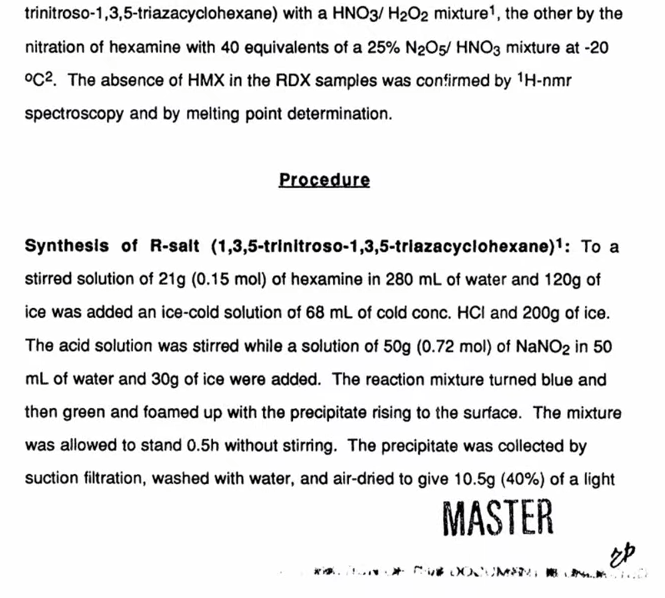
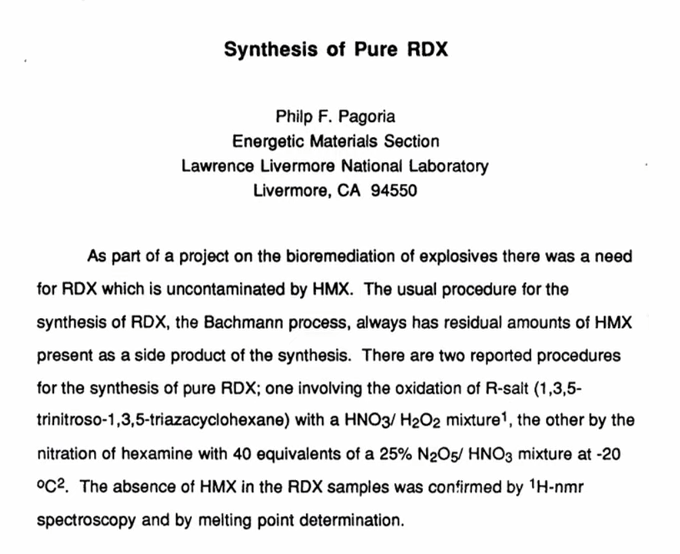
I synthesize energetics. I can make a primary explosive that is stable enough for cap usage with a solo cup. I can synthesize secondaries like RDX above (one of the more complicated common ones) in short order with a basic chemistry set and the internet to order basic reagents. None are controlled substances.
It is trivially easy to make effective shapes charges and energetics at home.
Synthesis is federally legal in the US so long as you do not assemble into a device or transport. You can do both with an SOT as an FFL.
If I wanted to, I could make a shaped charge that was point imitated and base detonated for the above projectile and it would punch through about 1.5 feet of homogeneously rolled steel.
The limit to threat is not the access to explosives, as the chemistry and processes are published freely online as easy to replicate. The drone parts and control surface actuation is by far harder and I say this as someone who has a professional background in computer science and software engineering.
It is trivially easy to make effective shapes charges and energetics at home.
Safely?
If I wanted to, I could
You’ve got enough information to try to execute the above formula. Okay. And you’ve still got all your fingers after attempting this… more than zero times?
The drone parts and control surface actuation is by far harder and I say this as someone who has a professional background in computer science and software engineering.
Absolutely. We invented gunpowder centuries before we invented airplanes.
That said… as an anecdote, I had a friend who had a janitorial position. Cleaning a particularly stubborn toilet and dumped a bunch of bleach into the bowl. His coworker came in behind him and proceeded to piss in said boil, creating a toxic miasma that forced them to exit the restroom quickly and heavily ventilate it before returning.
“I could cook up some blasting caps with the trash from a frat party” is a theoretically believable claim.
“Every time I clean up a frat party, I add a dozen shaped charges to my inventory” is not.
Safely? Yes.
Keep the reaction stirring under ice and if you see the temp rise above 15 C you dump the whole thing in a water bucket or you get a runaway exothermic reaction that is never good with a high explosive forming crystals in the solution.
If you are stupid, don’t ventilate, or are stupid stupid it will light your shed on fire and potentially kill you.
That’s why you work at lab scale, and why you always keep your reactions under the temp limits with acids added slowly.
Basic chemistry safety covers all the bases here.
My preferred blasting caps are nickel guanidine based. I can play with the crystal morphology to produce small more friction inert powder and it is an extremely simple synthesis.
You can use reloading press combined with highly suggested lexan sheet as a blast shield and wooden block to gently press the powder into caps. China sells packs of 1000 electrical ignition assemblies for $40 that you can then set off with a COTS or a clacker.
I cannot emphasize enough that working at small scale and knowing what you are doing are important, but in faster time than it takes to print the parts for that drone you can absolutely complete the reaction, do some recrystalizstion, dry your product,and be ready to mix with plasticizer.
I had a friend who had a janitorial position. Cleaning a particularly stubborn toilet and dumped a bunch of bleach into the bowl. His coworker came in behind him and proceeded to piss in said boil, creating a toxic miasma that forced them to exit the restroom quickly and heavily ventilate it before returning.
Lol, I’ve done that before in my apartment. Guessing it’s the same thing as an ammonia-bleach reaction.
urea-bleach but close enough.
The drone parts and control surface actuation is by far harder and I say this as someone who has a professional background in computer science and software engineering.
https://www.youtube.com/watch?v=RrzxSOtj33s
The model rocket community has this one sorted.
Oh the ones from BPS space are even more impressive with adjust on the fly tracking to 3D points and launched from a VLS he made himself.
RDX on youtube if you prefer visuals apparently i can get 2.5L of nitric acid @ 70% for $220. Seems pretty straight forward.
I don’t know why I feel the need to let everyone know the US trained birds to guide bombs in WWII. It seems relevant.
Plastic explosive triggered by electrodetonator is quite safe.
You don’t need explosives. It has a spot in the front for a camera. One of the new microcontrollers with AI accelerators can do face recognition extremely quickly. It would be possible to use it as an assassination tool.
Even if you changed nothing about the design, the speed and mass of the thing hitting a person in the face could kill.
As the bps space YouTube channel has shown, reliability is paramount in any launch, especially a guided launch.
That and people duck when shit flies at them, unless it’s supersonic, which again, as bps space has shown, control of a supersonic flight is extremely difficult to get right.
This is a guy who landed a hobby rocket like a tesla booster.
But at $100 a pop, you could have backups. (or payloads)
Why kill only one when you can do a whole blast and get a multi-kill?
It would be possible to use it as an assassination tool.
Khojayev’s just-launched prototype has no effectiveness track record
:-/
I think
it’s more like a high speed burrito delivery device.
Is a more accurate assessment.
You can deploy a lot of $96 semi-effective hardware and improve it vs something that might be thousands or even tens or hundreds of thousands to deploy.
You can deploy a lot of $96 semi-effective hardware
Khojayev’s just-launched prototype has no effectiveness track record
:-/
I mean, time will tell. To date, this particular iteration of technology has a 0% success rate in doing anything but farming clicks.
We got another scary 3d printer headline for dumbass politicians to use as justification for regulating them!
There isn’t much there that can’t be done with PVC and bent aluminum sheeting.
Hamas famously uses water pipes for their rockets (no idea about the propellant, payload or control systems though)
Don’t expect a bunch of moron politicians to understand that though. They’ll see this and think it’s a golden opportunity to “PRoTEcT tHE chILdREn!”
Unless they’re going to ban heating elements and stepper motors I’m not too worried.
It probably wouldn’t be too good for Bambu Lab so I wish them luck in their lobbying effort. They could buy a veto from Trump for a few hundred thousand USD in the worst case.
I mean, yeah, that’s why regulating it is stupid. But it will still cause problems for a lot of people if they start fucking with them. Not everyone has the time/talent to build their own 3d printer. It took me months to get mine working back when I did it and it was a kit. Trump can’t veto state laws.
It also has a 0% failure rate in live strikes on targets.
Not according to Wayne Gretzky
Notably absent… the explosives.
Not my area of expertise, so please tell me if the idea is complete garbage. With that being said: Theoretically, could the LiPo Battery that’s already in there anyway be turned into an explosive payload by intentionally overheating and puncturing it on impact?
Not my area of expertise, so please tell me if the idea is complete garbage.
Turning a laptop battery into a weapon is a non-trivial endeavor. The absurdity of TSA was more their attempt to police based on weak science than the real danger of an airplane full of lithium battery powered devices.
Not really an answer to you, just writing it here in case anyone else interested is still reading along:
I looked up some numbers and apart from the practical challenges of making a battery “go boom” in a controlled way it seems like the energy density to even make this a hypothetical option just isn’t there. Even the best LiPo batteries don’t quite reach 1 MJ/kg while gunpowder has ~3 MJ/kg, and numbers only go up from there for more modern chemical explosives.
I’d build and use one of these if I could get the explosives to go with it and the address of a CEO.
The United States has a variant of the AGM-114 Hellfire missile that replaces the explosive warhead with six scimitar blades. Because fuck That Guy, the whole That Guy and nothing but the That Guy.
Which would come as a surprise to hundreds of dead Iranian schoolgirls.
Turns out the military under Trump is more a “fuck that town in particular” affair.
You know, I’m still struggling to believe the story I’ve been told about that. “The US bombed an elementary school.”
For my entire life, the US has demonstrated precision munitions. The AGM-114 Ginsu is an air-to-ground laser-guided rocket that can kill an individual passenger in a car. We can fly a Tomahawk cruise missile into a specific window of a building. I’ve seen a bridge in Iraq bombed seconds after the last car crossed. Not saying GI Joe is a paragon of virtue, I’ve seen the pictures from Abu Ghraib, but…That shit sounds a lot more like Israel than us.
Even in the “no kill like overkill” “We don’t target coordinates, we target grid squares” “enemy fire is coming from that way, destroy that way” United States, that shit sounds a lot more like Israel than us.
We’re certainly attacking Iran because Israel wanted us to.
Lol. And that one village in Afghanistan you leveled, looks like who did it?
Oh, don’t even pretend anyone cares about Afghanistan.
One of the stills from one of the videos that the BBC showed identifying it as a Tomahawk showed it at a very un-cruise-missile way up, so it could just have malfunctioned during terminal guidance or been clipped but not destroyed by air defence, and then hit the wrong target. It could also just have been a governmenty-looking building close enough to an intended target that whoever was checking it didn’t notice it wasn’t the target. It’s a lot easier to get everything right when the whole mission is to hit one person with one missile when everyone’s got enough time to do their job perfectly and everything’s been rehearsed than when there are thousands of targets and people are doing things in a rush, especially if orders are coming from people who don’t care about international law.
I will also believe “war is hell, especially when waged by retards.”
Based on some reports, they used a decade old intel when that facility was used as a military compound.
It would take seconds to verify, with satelite imagery, that this was a school.
Trump admin also fired the department which was responsible for minimizing civilian casualties in an event like this. Cuz it was too “woke”.
Even if none of that was true, saying “it was israel” still feels like shifting the blame.
Even if it was israel, US military is mega complicit for not saying out loud it was israel.
Yeah I’ve seen those. The mind that thinks up these things aye.
I have this idea: Scientists some time ago, discovered they could knot light into loops.
Would it be possible to make a curved laser for laser artillery?
Certainly possible. But you’re still stuck on the r2 problem of diminishing returns at a distance. Light doesn’t like staying in a tight beam. The vortex loop is typically not much bigger than the wavelength. I don’t see much of a solution for transmitting energy long distances through air.
So it would basically be a Warhammer Lascannon, fuck.
Anyone know what the $2 propellant is?
Thanks!
That doesn’t seem to fit in the budget though??
Atomize* some propelant, boom, explosive.
* english choose the dumbest word for “zerstäuben”.
Atomize* some propelant, boom, explosive.
The trick is to get the atomized propelant to “boom, explosive” at the target and not in your backpack.
Also, you probably want a “boom” sufficient to accomplish whatever demolition you’re planning, which - again - raises the stakes regarding what’s in your backpack.
There’s a classic little film called “The Wages of Fear” that explores the hazards of amateurs transporting high explosives over long distances.
There are plenty of very safe HEs.
Tannerite comes to mind. It explodes from a high impact, and little else. I’m not sure what sort of yield you’d get. That stuff mostly just makes a pop and smoke.
I have heard of people using it on stubborn tree stumps, but that’s several pounds of the stuff.
I mean, spray the leftover fuel into the oxygen-filled head only on target? It wouldn’t stay atomized for long anyway. And for the boom, the shell needs only be strong enough. Wouldn’t that work?
Sure, there’s more effective explosives.
Wouldn’t that work?
Idk, you wanna find out?
Listen, if you’ve got the specs for military ordinance and want to say “We’ve done this a thousand times, it works fine” that’s one thing.
But it’s very much another to just wave your hands and announce “you know, the boom-boom juice goes here and the detonator goes there and it’ll probably do something.”
Atomize, from the original Ancient Greek adjective atomos, meaning “uncuttable” or “indivisible”.
Seems pretty apt to me. You have rendered it into its smallest constituent pieces through physical means, any further reduction requires chemical processes, or high energy physics. Coincidentally, a simple spark provides both.
Does that literally mean “make dust”? I think “powderize” might be a better translation in this context, if it’s a solid, or “aerosolize” if it’s a liquid. I’ve never been a big fan of the word “atomize” in any case.
I’ve never been a big fan of the word “atomize” in any case.
Mate, I’ll have you know some of my relatives are made of atoms
It’s uhh, for home defense
Home offence is the best defense.
Imagine spending thousands of dollars stockpiling assault rifles and ammo for your revolution only to have your entire milita wiped out when some nerd with a $100 homemade missile blows-up the UHaul you all piled in the back of.
All the MAGA civil war two types forget about the nerds. Nerds win wars now.
Only idiots bring a gun to a drone fight. However, it is perfectly acceptable to bring your limited edition Andúril replica to finish off any boogaloos that were merely wounded. 1d8 slashing (1d10 if using it two-handed).
Imagine the bloody khakis and blue shirts strewn all over… 😂

Aw, poor geek squaddies.
Bite the hand that kills your neighbor.
Clearly it’s just a big-ass gun that shoots 5000 caliber rounds. So it’s protected by the 2nd Amendment.
'Murica
Against invading homes? Do you get those a lot in your area?
Not anymore
What a time to be alive… For now
It’s vibe coded lol.

There’s an anecdote that comes up in software about people working on missile software not caring about memory leaks because it’s going to explode anyway before that becomes an issue.
Who cares about bugs in your software if it’s a hobby project that’s going to blow up anyway.
Also, including Claude doesn’t inherently mean vibe coded, it can be for writing tests, small components, or debugging.
Tests should be written from requirements. Using LLMs to write tests after the code is written (probably also by LLMs) is a huge anti-pattern:
The model looks at what the code is doing and writes tests that pass (or fail because they bungle the setup). What the model does not do, is understand what the code needs to do and write tests that ensure that functionality is present and correct.
Tests are the thing that should get the most human investment because they anchor the project to its real-world requirements. You will have tons more confidence in your vibe coded appslop if you at least thought through the test cases and built those out first. Then, whatever the shortcomings of the AI codebase, if the tests pass you can know it is doing something right.
Honestly, never been on a team that stuck to TDD. As you test your stuff, and understand whatever libraries and apis you’re calling you modify your implementation as you go.
For public facing methods, especially ones called by customers, having pre agreed upon tests matter more but usually that’s at the integration test and system test level. I usually use AI for unit testing and read what was written. Tests end up being a lot of writing harnesses and setting up mocks that you delegate to the model and if there’s gaps or incorrect requirements, you change them.
I would never let the agent define the code structure. It doesn’t understand business processes or what might need to be extended or we’re instead about.
I’ve been doing software for a while, I know how to review code. I don’t vibe code, I let the model implement boilerplate and mapping functions while I do other stuff, like manual testing or talking with product. If done correctly, you can incorporate generative models into your workflows without fully handing over all control.
Using an LLM to write tests and small components is still vibe coding.
Wikipedia says:
Vibe coding involves accepting AI-generated code without reviewing it,
If you are using LLMs to write e.g. small components, then you are typically understanding the structure of the program, and reviewing it.
There’s nothing inherent to small components to suggest that you have to review them. If they’re small, it’s easier to tell yourself that the LLM probably got them right and you’re justified in not checking.
Listen to me. I do code for a living. Nobody want to write HTML
Bro, if I don’t have to sit there for a half hour banging out code to map structure A on to structure B, I won’t. I’ll let someone else write it and spend 5 minutes to check that the code is clean and it works
Vibe coding is you not reviewing what the model outputs. I read every line, often give feedback and tell the model about patterns I want to use.
I probably write like 60-70% of the code myself.
deleted by creator
No matter how mad this makes people, its still true.
What makes the code actually useful in most cases however, is enough understanding of the program to modify as its needed. That’s where LLMs fall flat. Even when the code works, its terrible at adjusting the code to fit a specific use case. Dont even get met started on usable documentation or maintenance.
I disagree about better code. Claude has been pretty bad at understanding external context and deriving why you’re doing something from the implementation. This can result in wonky structure that you need to fix, or at the very least tell Claude to redo over and over untill it looks clean and organized.
Well, it is supposed to go boom
Good then that they haven’t put explosives in it yet.
Just need to do a little extra testing then. ;)
spoiler
Because Australia is Australia I’ll preface this with: this is a joke. Any depictions of high profile/high net-worth individuals in my area are strictly fictional and any resemblances are merely coincidental.
Anyone got some high profile/high net-worth individuals in my area?
just go to a junkyard and get some dead cars if you just need something to blow up.
So do I put the CEO’s inside the cars?
if you wish so.
Me in court next year: “I HAD PERMISSION!”
lachlan murdoch lives in sydney
i’m willing to give it a pass if it lets us take down drones
Can’t wait for the next Luigi to use one of these on an Epstein CEO. Polymarket, please let me make that bet.
If you can get the target out in the open, an old school pipe bomb from just gun powder and stuff from the hardware store on a drone is easier. Im sure for $1000 you too can become a patron saint.
Well said! I just appreciate the visual of Fox News covering someone named Mario firing a homemade shoulder mounted missile into the executive floor of Twitter HQ. It’s funnier than ever now that it’s actually plausible.
reads the title What the heck is Colin Furze up to now?
It’s not him though.
It really does feel like a random Colin video drop haha
This wont scare the think of the children crowd at all.
I don’t know, rockets are pretty phallic.
They are not afraid of the phallus . They fear the vginy.
deleted by creator
They’re afraid of the way phalluses make them feel.
That why the should be pointy!
Damn… Nerf wars gonna be crazy.
“Want to know how I got these scars? The Great Nerf War.”
If I’m understanding this correctly, this is more valuable to underfunded military forces but not for the 3d printed ghost gun types. This doesn’t include propellent or explosives, which are the controlled parts. That’s awesome though.
If you can buy bullets… Or gasoline.
I assure you those do not magically translate to rocket propellent and high grade secondary explosives.
Uh-oh…
Ground private jets
That’s one way to reduce billionaire CO2 emissions

Probably would be the only way lol.
“You ain’t flying over this town ever again.”
In case you haven’t done so already I suggest reading The Ministry for the Future.
I started that one but fell off pretty quickly after that brutal opening chapter. I think it was too heavy to read in the middle of COVID. Thanks for reminding me, I’ll give it another go.
Yeah, the first chapter is hard to swallow, and compared to that the next ones feel kind of underwhelming. The book often changes pace, however there are no more gut punches like the first chapter, if that is what you are concerned about.
I prefer mine grated so they still have a little bite.
Get these to the Children of Kali.
That’s fucking nuts.
I have a lot of thoughts, but all I can really say is that’s fucking nuts.
Neat. I wonder if there is anything you can use as a warhead without it becoming a destructive device. Chalk rounds?
I’m also curious to know the rocket velocity compared to actual MANPADS. I’ll have to watch the videos later because I’m also curious about whether they’re independent or require the launching laptop to stay connected.
Velocity and range are also my main questions, as well as tracking quality and speed. The video doesn’t demonstrate it hitting a flying target.
Common MANPADS like Stinger, Strela, etc. use infrared tracking. The seekers are high performance and fast but need complex supercooling with gas. Using a MANPADS you only have seconds, to arm, aim and track, then fire the missile against a fast moving target before it‘s out of range. These can hit low flying supersonic jets.
Still this project is very impressive and hints at the possibility to build cheap low end MANPADS that can target slow moving strike and observation drones, maybe helicopters.
It’s another indicator, that mass produced cheap precision weapons are a major trend in warfare.
Potentially could be used for things like spreading flame-retardent powder for putting out a wildfire or similar with more precision. Would also remove the risk of a human life in firefighting so areas might be cleared quicker.
Already behind the times on that: https://arstechnica.com/gadgets/2026/03/firefighting-drones-head-to-aspen-can-they-suppress-a-blaze-before-humans-arrive/
Cheers then, add this to the “arsenal”.
I don’t see a lot of info on payload in that article. Forest fires are big. You’d need an enormous fleet of drones to be effective.
I can contribute that the goal with the drones is to help contain small fires before they spread - they aren’t there to stop the fires, just slow them down until humans can get there with the serious equipment.
This is the same kind of thing the local Airsofters were building with an arduino and a few hats a decade ago. It’s not a functional “weapon” it’s just a hobby rocket with fins (that admittedly looks real fun to shoot)