You must log in or register to comment.
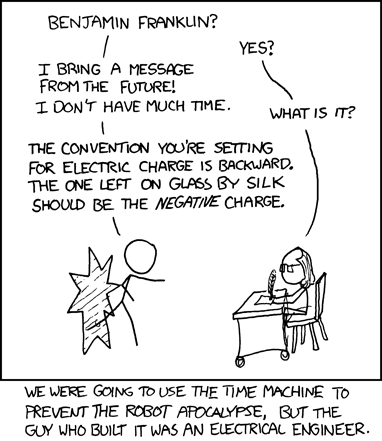
Turns out Benjamin Franklin had it right, and it was this time traveler that caused him to flip it to the wrong direction.
While funny, this doesn’t work because the time traveler told him specifically which one is negative.
“… Well now I’m not going to do it.”
Damn time travelers,
alwaysnevermessing things up!
Man, this one is a good one.
IMHO Franklin is one of the few who would go straight to “what is it?” without blinking.
The comic accurately portrays him as nude
Always love their comics but since I don’t know crap about this stuff it’s amusing to see how this one is relevant to a meme. Wish I knew more but only so much I’ve learned so far. One day perhaps but not today.
https://www.explainxkcd.com/wiki/index.php/Main_Page
The contributors on this site do an excellent job explaining the comics. Not really ELI5, but more ELI15.
It’s okay to not understand every comic, someone else out there figured it out and explained it to us.
Very much appreciated, thank you I’ll never understand everything but I’d at least like to have a bit of an idea.of what I can.
I just want to add you only have to insert the word “explain” into any xkcd URL like this, to get the full explanation from the fan site: https://xkcd.com/567/ https://explainxkcd.com/567/
Just makes it simpler to navigate to an explanation of some random xkcd comic you come across.
Learn a other new thing again appreciated, I don’t think I’ve heard of that one…or did years ago and memory failed hard to tell heh. Always nice to realize new things so thank you.
You just have to ignore the existence of electron flow. Conventional current flow is all that matters, and the only people who use electron flow are those who design integrated circuits and lunatics
You forgot science enthusiasts who are desperately trying to impress people.
They get lumped in with the lunatics
We don’t want 'em.
You mean the writers for “IFL Science”?
Yeah, we don’t want them. They’re idiots
Stupid meme sharing fuckers.
You mean to tell me that there are people out there whose job it is to design lunatics?
That’s fucking awesome. Like a real-life comic book author.
Let’s eat grandma
Depends on what she tastes like.
Wolfie will know!
It’s also useful to think of the “ground” plane as a sort of well of potential charger carriers that the conventional current model overlooks. Aside from simultaneously visualising what’s happening inside simple ICs like BJTs / MOSFETs and the circuit diagrams I’ve found it a useful way for checking for common mode noise in circuit and PCB design.
I guess this makes me a lunatic? Don’t know until we test it;
Someone give me an
asylummakerspace to takeover!It’s also useful to think of the “ground” plane as a sort of well of potential charger carriers
I…think I understand ground loops (audio) now.
Are you implying that there are IC designers who aren’t lunatics?
I gave up on thinking about it (at least, DC) as flow, and started thinking about it as pressure. It’s a small mental flip that made a bunch of things easier. I’ve also heard people talk about it as the movement of holes where electrons are not.
Also chemists doing electrochemistry where the direction of electron flow is very important. You also have to deal with anode and cathode being flipped from how you expect since you are putting current in instead of taking current out.
You just have to ignore the existence of electron flow.
And ignore magnetic fields completely?
In a lot of cases, yes. 99% of the time when designing electronics / electrical circuits you can safle ignore them.
I was joking. But it does matter more with analog circuits.
And that’s why we have positrons instead of the much-cooler-sounding negatrons.
Man, they have positrons and negatrons now? The Transformers franchise is wild.
We gotta keep them out of sports, they are too strong.
The south^of Cybertron^ will rise again?
Oddly when it came time to negotiations, they somehow realized actually calling yourself a Decepticon, was not a good name for inspiring trust.
For some reason every Negatron in the last Michael Bay movie was black.
I have a feeling that in antimatter circuits the positrons would move the same way as the electrons in equivalent matter circuits
Well sure. And in that universe, electrons might be called negatrons.
“all models are wrong, but some are useful”
I would even go as far as to say that models are neither right nor wrong, they just are what they are. Like a flower is not right or wrong for blooming a certain way, it just does what it does and does not care about your right and wrong. This is simply because there is no morality outside of human society and therefore no way to establish right or wrong.
In fact, it is us who are right or wrong when we are using a model. We can use it in meaningful ways or nonsensical ways, it’s our choice. That’s why it’s us who are right or wrong.
Who are talking about morals?
If I make a model of gravity which says that earth has a gravity of 1000000 m/s^2 then that model would be wrong.
No morality question at all.
Your comment however feels like an AI trying to justify the existence of AI models through the argument of “guns don’t kill people, people kill people”
The current does flow from positive to negative. Electricity is not the flow of electrons - they just generate the field that the electric wave flows through. The electrons don’t actually move very far. The wave flows outside of the wire, not in it.
The only correct answer 👆🏻
I came here to post this same video. It still blows my mind.
not this again … wait i wonder, does this apply to coax cables as well?
flows outside the wire, not in it
Yet it propagates at the speed of light in the material the wire is made of
It’s not meaningfully outside until its outside an antenna
No, it propagates at the speed of light in space.
Electricity is not a real-concept, it is a qualitative aspect and the elec-root is what defines that aspect. There is no such thing as electricity, to cut it short, it’s like talking about “Science”. There is the scientific method, scientific advances, natural science which is a category of academic research, but science is a broad abuse of language, same thing goes for electricity when people picture “the blue stuff that flows in wires”, it’s reductive, ignorant and meaningless when you can talk about electrical arcs if you mean the “blue stuff”, electrical current, electrical charge, electrons if you refer to the subatomic particle allowing this exchange, electrical energy is the volts per coulombs, etc.
But there is current and in direct current, those particles flow as historically, that was the first convention for current, AC operates through frequency oscillation. Also, electromotive force is what causes the movement of electrons, the magnetic field is just a componenent and does not induce EMR and the energy generated by it is akin to mechanical “work” caused by kinetic forces. It boggles my mind how even modern electrical engineers sometimes get this wrong.
You are wildly misinformed about how language works.
Unless you can refute the below cited sources (which I doubt even I could despite teaching at the graduate and undergraduate level), I will assume you have just replied because of cognitive dissonance or lack of awareness of preconceived dogmas of how the dynamics of knowledge and linguistics work one with the other:
1-https://en.wikipedia.org/wiki/Etymology_of_electricity
2-https://link.springer.com/article/10.1007/s10728-012-0231-2
Fun fact, the disconnect between true academic knowledge discoveries which are bound to a very strict code of ethics, do not apply to the common working man. This creates paradoxes everywhere, especially at the fundamental level and english, being a language not regulated by a linguistic body like French is by the Académie Française. It becomes even more interesting when looking at very old languages that still are able to function like arabic which is 3000 years old and has morphed into common domestic tongues for the most part but is regulated by the Majma’ al-Lugha al-'Arabiyya as a theological unified language in Cairo and Chinese which is 1800 years old and regulated by the Guójiā Yǔyán Wénzì Gōngzuò Wěiyuánhuì (National language commission, or 国家语言文字工作委员会 ) and has had a modernist revision which gave us mandarin or “Simplified” chinese, building onto older “Traditional” Chinese.
This reads like an LLM with a large vocabulary failing to understand the actual context of the conversation. Lots of big words hurled with reckless abandon, lacking any real meaning and having little to do with the actual point.
I don’t like it
Yeah most of their comments give me that “am I having a stroke” you get with LLM output. If they’re not a bot I have no idea what they’re saying, at any rate.
Not relevant to whats being discussed. I wish rather than delete the comment, mods are able to flag it as AI and users can choose whether to see AI posts or not.
Random thought.
PieFed has this feature.
I’m going to be honest, I don’t think I’ve ever been confused when someone used the word “science” before, and it is usually pretty cut and dry what they mean when they use the word “science”.
“The sciences” - Various fields of study using the scientific method. “Doing science” - Using the scientific method to explore some hypothesis or harden a theory. “Scientific advancements” - The furthering of knowledge using the scientific method.
I would think most people feel that “science” is not an abuse of language, but a very clear and useful term, both in and outside of academia. At least with “science” it all revolves around the study of nature, usually through the scientific method. “Electricity” seems more like a vehicle, with parts that have to come together just right or you end up describing an entirely different phenomenon.
“Electricity” as you’ve defined it, is fucking wacko, and does not parallel “science” in anyway I currently see. I’m not saying that you’re statement makes you wacko, but that the culmination of these esoteric concepts makes up what we think of as a broad categorization of “electricity” is wacko.
Your explanation was really enlightening, actually, and while it took me a moment to acclimatize to the information, it was very helpful. Thank you.
Thank you for your reply. I’m new to Lemmy, and while replies like yours are why I’m still falling in love with it (since no platform has felt as representative of the human experience as Reddit before Helen Pao) it is a genuine pleasure to be met with careful intellectual consideration rather than misguided reductionism.
To address your point: yes, it is true that there are alternative ways to describe the practice of human abstraction of the natural realm, or “Science” which is a word that will be met by scrutiny under any ethics review for a university paper but works perfectly well in the common and fun daily discussions of any intellectually curious human.
Karl Popper is the one who perfected this for us, owing to the parallel contributions of two Jinns of knowledge who shook human and natural disciplines to their foundational assumptions: Einstein and Freud . Each published groundbreaking works using profoundly different methodologies. Popper, perhaps unintentionally—and arguably by mistake—brought this tension into sharp focus, setting in motion the philosophical move that ultimately negated Freud’s claim to scientific status and is now an (imo highly slanderous) general point of view that psychoanalysis has no merit and should therefore be discarded. By extension, this helped solidify a framework in which only certain forms of inquiry were deemed truly “scientific.” This, in turn, is why naturalistic physical abstraction and the echoes of scientism are now “painting the walls white” in every reflection of what we understand our world to be.
I was initially drawn into this because I am male and a lover of all scientific knowledge—knowledge acquired through hypothesis synthesis, verification via empirically and statistically supported evidence, and peer review. I also practice and teach at a Canadian university, though I’d prefer not to leave identifying details online. My husband (a brilliant art historian and big advocate member of the LGBTQ+ community and reform of logically outdated concepts such as race, gender, work and others), had the insight to engage me in a careful, sustained dialogue debating and reflecting on every facet of my materialist worldview. Through this, it became easier to understand why societal mental health is in its current state, and why humans seem (at least to my eyes) less self-aware than in prior eras. It had also a profound effect in allowing me to understand so much of myself and only got better as I became more and more nuanced in how I abstracted upon thoughts. But it also kept being a friction point on linguistics and academic nomenclature and yes, I do still believe that the abuse of language often made by calling academic disciplines “Science” is why “common sense” and popular points of views have done such a disservice to “human sciences” (despite them not using the scientific method).
This dialogue brought me to realize that the natural sciences are merely the tip of the iceberg, and that humanistic discourse plunges into far deeper waters. The journey has been mentally taxing, if I may share my lived experience, and I now feel a certain intellectual jealousy toward my husband’s discipline. I’ve come to believe that the humanities, scientism, and, by extension, the common abuse of language (such as treating “Science” as a monolithic entity) do a profound disservice to the second half of what it means to see the world as a human. Human and Natural sciences operate in a dichotomy after all and this is why the world can be interpreted as; There is everything outside of you, and then there is everything inside of you. The interior world remains a profound puzzle, one that still demands enormous focus. In my view, significant reforms in scientific methodology are urgently needed, especially as the dominant model has been a systemic impediment to disciplines like psychology and anthropology. And if I can pique your curiosity; below is a good paper on the issue if you happen to be tied to academic practice and if you are looking for a good challenge, natural sciences (in my eyes as I now get older and wiser) are total child’s play compared to how more robust and taxing humanities can be from a logical standpoint.
Most circuit diagrams do not draw current flowing in any direction at all. It’s just labeled + and -. I don’t see anything wrong with this.

deleted by creator
Logically the switch comes before the bulb.
That depends, do you want high or a low side switch? There are valid reasons for either depending on what you’re doing.
One that is less likely to kill me. Low side switches leave a “floating” load at the supply voltage that could leak to ground
I’ve left a floating load that leaked to the ground before.
I’m confused are you saying that negative voltage is more deadly than negative voltage? Just because electrons flow from negative to positive doesn’t mean it’s any more dangerous what moves the electrons is the voltage potential. If you were able to have electrons flow from a source through you to the ground your just as able to have electrons flow from the ground through you to a positive voltage source.
They just don’t know what they’re talking about. Mistook it for AC, where one usually wants the switch on the phase side.
You sent me down a rabbit hole wondering if AC batteries are a thing, and apparently they are! I’m still not sure if any of the sources I found are scams, but they seem to be physically plausible. Interesting!
there are no ac batteries by definiton
I don’t see any mosfets here
I’m saying there is more shock risk…
Switching the low side can also be dangerous in high-energy systems because the live conductor is always in circuit even when the unit is switched off. Switching in the high side ensures power is removed when the unit is switched off.
But the current doesn’t care
Current propagates at the speed of light in the conductor. It really doesn’t matter which side the switch is on at human timescales
The convention puts them on the positive side; people who understand the convention is [mostly] wrong put it on the negative side, but it doesn’t matter
But then I get to talk about all those holes flowing.
Uhhhh…pornhub is that way ----->
Wait, no, but first, imagine marbles in a straw!
Pornhub is that way ----->
Imagine a chain getting tugged back and forth
Pervert.
I’m sure someone has uploaded some current diagrams…
OMG-O-S-H every circuit designed with conventional current just exploded because of your revelation here.
/s
My friend, this is the same branch of science that got us to space with calculations assuming spherical cows.
While we’re at it, is a compass needle’s North pole actually a South so that it points North? Or is the Earth’s North pole actually South so that the needle’s North pole points to it?
(I know that I could look this up, I just want to confuse people.)
But that’s by design, while this is a convention problem
We decided on North long before we discovered magnetism. But the magnet poles of the earth flip from time to time so ehhh.
The needle used to be called the north seeking needle. It is magnetically south
Couldn’t you fix this by also defining electrons as positive? Imo the physicists and electrical engineers should fight it out.
All words are just made up.
The physicists are absolutely right. However, I reject their reality and substitute my own
That sounds like the electrical engineers I know
No I need cations to be positive because the t in the word looks like a little plus sign so that’s an easy way to remember which is cathode/anode or cation/anion.
This was very helpful on tests.
So, it doesn’t actually change anything; everything still works the same.
But textbooks need to be thrown away and remade, every circuit diagram, every electrical engineering plan, decades of research and research papers have to be combed and corrected, or accept that they’re wrong.
While technically possible, it would create colossal risk and unending chaos and It’s environmentally unsound, for something that doesn’t change anything in the end.
Lazy is not checking your mail.
Refusing to turn reality on its head for a null change in the end is something else entirely.
They don’t have to remake the textbooks in some cases - I’ve seen electronics (college) textbooks that were printed in 2 different versions for Electron Flow and Hole Flow.
Refusing to turn reality on its head for a null change in the end is something else entirely.
I do agree with you, just want to give voice to the other side of this. Don’t underestimate just how much of a barrier this confusion is in teaching. It’s confusing. Students who are new to electricity almost universally hate this, and in some cases it can cause misunderstanding, miscommunications, etc. There is a genuine cost to this mislabeling, and there would have been effectively no cost if electrons’ charge was considered positive instead of negative.
As I said, I do agree that in practice, with all the existing knowledge, writings and technologies that all agree that electrons are negative, it would be a global disaster if the labeling was switched. There’s no question about it. But I kind of disagree about “null change”, it’s true that it wouldn’t change what we can create or (almost) any of our equations, but it absolutely would make it easier to teach it to future generations.
My electronics teacher weathered it pretty well.
This is a basic circuit. These are how the electric and magnetic fields work. Oh and Franklin fucked up a long time ago, made a guess, and he guessed wrong. So, realistically, electrons flow from negative to positive, and the holes they leave behind flow from positive to negative. (he had already covered PN junctions so it scanned) It doesn’t change the math or anything, just know that electron flow is negative to positive and that’s the last you’ll hear of it. And we all said that’s dumb. And now, in my life, this is like the 5rd time I’ve talked about it since I learned it in 1992.
Eh, i’ve struggled with this for years but eventually found my peace.
You see, there’s two types of electric current: Electrons moving through a wire, and protons moving through water (the second one is also called a pH gradient, it happens e.g. in cell membranes of chloroplasts, fascinating stuff, check it out).
Basically plants do photosynthesis, which is extremely similar to what solar panels do. They generate an electric current, and in that current, positive charges move, so the “direction of current flow” is the correct one.
I have come to accept that the current inside living beings is more important than the current in all the machinery, because without life there would be no machinery, so life deserves to get the “correct” current.
This is such a good view of it that it also makes the professors I had that make the joke about it going backwards seem silly.
A lot of the old experiments on electricity were done with like paper dipped in salt water so of course physicists would lean towards defining it this way.
feels like this should be a skeletor quote!
True, but most of laws, equations etc still work and only specific fields need to adjust for this.
But then you have to flip from the left hand rule to the right hand rule!
Could someone explain what makes one pole negative/positive? Like, could we have named them Alice/Bob or is there a specific reason we went with +/-?
Guessing here, but +/- is good for describing them as binary opposites as that system already exists. This is a good thing assuming there are two types of charge/pole which behave in opposite ways (Eg move differently in a field). It’s also just good to use numbers so that we can describe the amount of + and the amount of -, which numbers already do. It also allows us to describe neutral as neither + nor -, but 0. Again, we already have a scaffold there for numbers and it’s easy to copy it for new things when that makes sense.
Magnets.
If there’s no field there’s 0, if there’s a magnetic field clockwise it makes a positive charge, if there’s a magnetic field rotating counterclockwise it makes a negative charge,
Likewise if there’s a positive charge it makes a clockwise magnetic field and if there’s a negative charge it makes a counter clockwise field. (I may be backwards +/- clockwise/counter clockwise, something about the thumb on my left hand…, but really it’s all arbitrarily named, but the reason you just say negative or positive is that those are scalable measures, you can’t have half a Bob or 2 Alice. )
Since they are quite good opposites, the smart people who figured how all this worked decided on that and we stuck with it based on convention. Like how “Alice” and “Bob” were used in Computer Science since they are generic names beginning with the first two letters of the alphabet (it could have easily been any A and B name, but this is the convention!)
Similar can be said for magnets, the “North” and “South” poles are good opposites. If other people started the trend, we could have easily gotten something else, but this is the convention.
Another example, the use of “abc” and “xyz” in Mathematics. Or “ijk” as index variables when programming loops.