You must log in or register to comment.
 (not my meme)
 (also relevant, also not my meme)
I don’t know about Portuguese but there is a meme about English:
[UK flag] English (traditional)
[US flag] English (simplified)
Which is not really historically accurate because both standards developed more or less simultaneously after independence and before standardization, the variety was greater than the difference today. But I digress.
The Voice Of America has a standardized Simplified English they use for broadcasting to regions where English isn’t commonly spoken.
There was also that attempt at destupifying English spelling, a very small amount of which stuck. Color.
Getting rid of “u” in a small subset of words is a terrible way to try to simplify English. The fact that some words in standard English (as opposed to American English) are spelled the same as the source words from French is a major benefit.
Properly simplifying English would involve getting rid of the situations where one letter can make multiple different sounds. If you’re changing it, a word like “colour” should start with a “k”, the unambiguous letter that makes that sound. A word like “cell” should start with an “s”. Really, “c” should never make either an “s” sound or a “k” sound. Maybe it could be used in place of “ch”, instead of needing two different letters to make that one sound.
If you wanted another place to start in simplifying English, you could tackle letters using “oo”. There’s no way that “oo” should make different sounds for “pool”, “flood”, “book”, “door”.
spelled the same as the source words from French is a major benefit.
What benefit would that be outside of linguistics?
A word like “cell” should start with an “s”.
But isn’t it a major benefit that it’s spelt like the Latin root?
(I’m not in favour of force-simplifying spelling conventions, I’m just curious about your reasoning :) )
What benefit would that be outside of linguistics?
It helps with translation, with knowing the origin of a word, with having a general idea how to pronounce something, etc. Fundamentally, it comes down to “if it ain’t broke, don’t fix it”. Those letters in that order can have that pronunciation in English, so why change the spelling from the origin language if you don’t have to?
But isn’t it a major benefit that it’s spelt like the Latin root?
If it were “cella”, then maybe. But, even then, probably not. The main senses in which “cell” are used now are only indirectly related to the original word. “cella” meant a small room, or hut. It didn’t mean a room in a prison or a small biological unit. It’s a word with a different meaning with different spelling. It’s not really worth keeping some of the letters from the original spelling for a completely different meaning, especially because the letter “c” is so bad when it comes to confusion between the “c” and “k” sounds.
Basically, it comes to the idea that if you’re going to address issues in the spelling, they should be the “worst offenders”, otherwise changing the spelling causes disruption for no real benefit. They should be the letters or sequences of letters that are hardest for English learners to understand.
I don’t think the “o” vs “ou” in words like “colour” are even in the top 50 of those, whereas the “c” being used as a /k/ sound in colour is another matter.
I was specifically referring to this which proposed many of the changes you’re talking about, but very few were actually adopted.
Some of them were adopted and seem like they were good ideas. The removal of the “u” from words like “color” seems like it was one of the changes that was made, and one of the least useful ones.
There was also that attempt at destupifying English spelling
There have been plenty over the decades
The Voice Of America has a standardized Simplified English
That’s a good thing but not at all what the meme is about. It’s about words like color vs colour, center vs centre, … The American is arguably easier (and I say that as someone who learned British English at school) but it’s not simplified. Simplified would imply that British is older which isn’t the case. Pre-standard was “anything goes” on both sides of the pond and you can argue historically for what every you like.
I just listened to the latest Words For Granted podcast episode and it was about the book Enough Is Enuf which talks about the history of the spelling reform movement going back to the founding fathers. I thought you might be interested in it too so I went back to tell you.
Anytime we destupify English, we do it the wrong way and end up more stupider.
I’m looking forward to getting some Asian loanwords and then correcting them to Germanic.
In 200 years people will wonder why so many English words used to describe fiction and pornography are loaned from Japanese.
Am Portuguese, can confirm.
Continental drift. This was a part of Brazil that broke off and drifted across the ocean. Then it joined up with the rest of Spain, which had broken off from Mexico. That’s why the rest of Spain speaks Mexican.

And France is just a part of Quebec that drifted away.
France was actually two parts of Québec that drifted separately and then rejoined later on. The Paris region lingered in the ocean a bit longer, and people got accustomed to thinking of it as an island. That’s why they named it Île-de-France.
I thought Brazilian was a number
“Two Brazilians died in a car accident.”
Holy shit, what a mess.
I can count to brazillion. It’s a lot of tits.
It’s a wax.
Its the word Sheldon Cooper says in Big Bang Theory when he delivers a pun on someone else’s costs.
You’re both wrong, it’s a kind of fish
Saw a student once using the term “Port of Guesses” unironically in a final submission.
Like, how do you fuck up that badly that you don’t notice that? I mean obviously it was just laziness, but still.
So now I’ve got a minecraft village named the Port of Guesses in honor of that nonsense lol
Almost as bad as that report for “Youth in Asia”
Or that neurodegenerative disease the elderly get, “old timers”
“They tell us how to run our lives, we run for youth in Asia!”
– Dave Mustaine before proof reading the lyrics of one of the best albums in the history of music
“David Mustaine”
– me before proof reading this comment 🤦🏻😄
“Yeah, they gave it to some kid in china or something”
What does it correspond to?
Euthanasia
For the longest time as a kid I really wanted to know why my church cared so much about Asian kids.
I started saying “US of A” out loud because of internet memeing and one time it slipped during a (non-English) language class. I genuinely didn’t clock why people were laughing. I didn’t register I said that instead of the proper way.
US AND A

VERY NICE
Genuinely - as a non-American - what’s wrong with saying “US of A”?
Nothing. I’ve heard it used occasionally for decades.
Because of our American exceptionalism we forgot we were a part OF the americas. So now we are THE USA. Hope that helps.
I meant to write “US and A” like the above comment pointed out 😄 But either way, if inserted out loud while speaking a non-English language, it’s weird. Especially if people you talk to aren’t chronically online, lol. Imagine speaking German and then unironically saying “US and A” in English.
I know it’s a shitpost, but here’s an interesting piece of History:
- Back in the late 15th century, before Christopher Colombus officially discovered the Americas (more on that later), the Portuguese and the Spanish made a Treaty - the Treaty of Tordesillas - where they divided the World in half, each one getting one half of it.
- Whilst making the Treaty, the original proposal was that the dividing line (remember, this was before the first trip around the World) would be a North-South line, located 20 nautical miles East of the Cape Verde Islands (which are just
EastWest of the coast of Africa). With the Portuguese side being to the East of that line and the Spanish side to the West. - The Portuguese refused that location and instead wanted that line 20,000 nautical miles East of the Cape Verder islands, which was what ended up in that Treaty.
- Where is now Brazil is to the East of that line, on the Portuguese side, and the rest of South America is to the West of that line, on the Spanish side
This is why the Portuguese and the Brazilians speak the same language, whilst the rest of South America speaks the same language as the Spanish.
Nowadays it’s actually believed the Portuguese discovered the Americas before Christopher Columbus did (hence explaining the insistence on the location of that line in the Treaty), though there’s also proof that the Vikings discovered the Americas centuries before that.
And the Chinese before that, and what we now consider the native people before that, and tiny sailors from Africa before that.
I havent heard about the african sailors before - can you point me where i could learn Mord about it ?
I will also throw polynesians in - since the sweetpotato had to come from somewhere
There is very little information on them, but they left evidence and stories all over. Off the top of my head
The native Hawaiians maintain that there were people who lived there already when they themselves got to Hawaii. They called them the Menehune. Most modern descriptions label them as an ancient, mythical people but the original Hawaiian descriptions did not portray them this way. They firmly maintained that people lived there before them and they all shared the island for untold generations.
The Olmec colossal heads in Mexico are likely depictions of these people
The Ishak and the Uma, two native people from the Louisiana Coast were tiny, and very very dark brown to black skinned people who did not share cultural or physical similarity with the taller native groups throughout the rest of North America. I know at least one of their stories comes from a time of dramatically different ocean levels. They passed down that when the ocean rises and won’t stop, you have to walk to San Antonio essentially. Compared to elevation maps of a full melt, they are right. They also have stories of the entire bottom half of Louisiana disappearing and eventually showing back up.
One of the oldest stories passed down by the Gunditjmara people of Australia that can reliably be dated and located in Australia, is from 40k years ago. They have older, verifable stories, the oldest being 100k years, but they deal with the sky so scientists say they were in Africa at that time. Though they themselves maintain they were not. They also have stories of tiny seafaring master builders, just like in Hawaii.
Everywhere I’ve mentioned had very ancient, giant structures. In some places, only the foundation remains. Everyone always remembers how deft these people were at building. They were always remembered as being small. They had black skin and African features. They are from so very long ago that they must have come from Africa.
It makes sense that the first successful sailors were tiny. They would need dramatically less space and less food. We already know Africa has an ancient, genetically destinct line of tiny people.
You can’t just Google up any information on any of this unless you already know specifically what you are looking for. Colonized history absolutely will not abide information about a powerful, ancient Africa. The whole of the European historical record is now and has always been, overtly hostile to it, but the proof is everywhere.
You can find it in first accounts, ancient depictions and stories, and absolutely beyond ancient foundations. I mean, even giant Greek and Roman buildings, themselves ancient, have been found to be built on foundations that make the current structures seem young, and the current giant marble works, seem small.
There was a people doing great works all over, a long time ago, and Europe would rather deride it as “ancient aliens”, than the simple, evidence based truth that Africa, all our motherland, was obviously first to the world’s throne.
Did I actually encounter a Hotep in the wild, or is this a well written shitpost? In any case: You not being able to google that is not because of the (existing) white-supremacy, but because it’s just a silly larp. Anyway, if you think this is real and makes you happy, you do you, but no, there is no evidence for a global empire anywhere at any point in time, be it from any continent. If it makes you feel better, there have been huge, rich, powerful empires in Africa and that is pretty much undisputed. I know this was likely just a shitpost, but it does confuse me why people feel the need to spin such tales and seriously believe them.
I never said it was an empire. It was probably just early people really good at building on land so they tried and succeeded building on water, and they happened to be at a daily caloric intake and a generationally coastal diet that made long voyages easier.
Then they just sailed around the world over a few thousand years or ten. Probably on what we would consider boats far far to primitive and small to do it, but nevertheless they did it.
The fact that you needed to build a strawman, the very familiar tones dripping off your words, and that you assumed my race and belittled me for it, speak volumes about your personal isms and beliefs. You are a shining example of how and why this information, when it appears in the geologic and oral record, is treated poorly and promptly discarded.
When did I assume your race? I called you a hotep, but that was referring to the ideology, you could be as white as toast for all I care. I did not build a strawman, you’re saying a population was different from others because they ate different things and due to this they were able to colonize the world? Oral history gets distorted. What geologic fucking history do you have? If you’re referring to what you believe are the foundations of huge buildings, that wouldn’t be geologic evidence if it was built by humans it was probably transported and the geologic differences would have to be looked at in context. Which I’m sure actual geologists have done. (I’m now assuming you’re not shitposting)
You keep building these, you’re gonna scare off the crows!
I think I have seen claims that EVERYBODY made it to the Americas before C Columbus. In no order: the Vikings (might be true)
the Irish
the Romans
the Egyptians
the Basques
the Phoenicians
the Polynesians (probably true)
and, of course, people from AtlantisI once heard a great science presentation using sweet potato genetics to make a timeline of Polynesian island inhabitance and it blew my mind. And since then, there is genetic evidence of S American indigenous DNA in some Polynesian populations.
I also heard that Christopher Columbus tried to secure funding for his expedition, aiming to reach India without sailing around Africa, from the Portuguese Crown before approaching the Spanish one, but he did not obtain the funding.
Some take this as possible evidence that the Portuguese were already aware of a potential territory to the West that would block or complicate the voyage to India via that route.
The Americas are to the west of Europe… 🙂
And to the East, unless you’re a Flat Earther.
No seriously you mixed up East and West.
20,000 nautical miles is well over half of the Earth’s circumference. Where was east and west mixed up in the post? This seems like a “three rights are a left” situation to me.
If you go that way OK but it’s a weird way of saying it.
But Cape Verde is definitely to the West of Africa, not East.
Ah, okay, I wasn’t familiar with Cape Verde’s location, so my brain didn’t even process that part.
Yeah, you’re right on that one. I’ve corrected it now.
I kept checking all the other mentions of East and West but didn’t spot that one.
Did you know that American is also northsouth of Europe? Just go north and ignore the pole, just keep going on a straight line south.
Just go north and ignore the pole,
What’d he do this time?
Look just don’t talk to him. Just don’t.
And to the east. That’s the thing about spheres…
😘👌🏼

Some people still know how to make shitposts with deep stank .

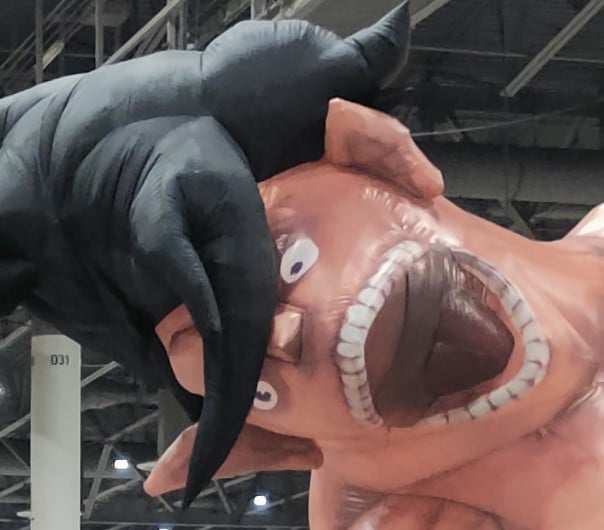
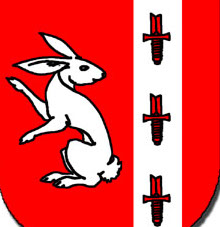
I blame Afonso Henriques, pictured below

I don’t think I’ve seen a Riddick reference in… my entire life?
But I’ve just watched it, for the first time in about a decade, and then the next day I see a screenshot of it on Lemmy?
Dead internet theory must be real
Pitch Black is worth watching.
The Chronicles of Riddick… meh, Karl Urban delivers though.
Riddick is a dumbass Pitch Black rip off in the guise of the third instalment in a trilogy that never was.Maybe I’m a bot who has been monitoring your entertainment traffic specifically to incept this shit onto your monitor.
Or maybe I just got through a Fast and Furious rewatch and had Vin Diesel’s “This is Brazil!” lodged in my brain, but opted for this picture because it isn’t just him in a wife-beater yelling at Dwayne Johnson.
How to piss off at least three sets of people in one shot.
Better question why does a country sharing two land borders speak a completely different language to any other country.
Edit: Y’all forget the French
There’s a lot of similarities between Brazilian Portuguese and Spanish. Most Portuguese speaking people can understand basic Spanish but it’s harder for Spanish speaking people to understand Portuguese.
At least that’s what my wife tells me as a Spanish native ~150 days into learning Portuguese.
IMO (formal) American Portuguese and Spanish are pretty close to mutually intelligible, especially in writing. There’s a surprisingly consistent “system” for converting words between them and once you notice it, it’s pretty easy to tell what a sentence should be in the other language, if it’s even spelled differently in the first place. The grammar is also very similar. The biggest difference that gets me is how Portuguese tends to shift past tense conjugations further into the past vs Spanish.
I’m just curious, do you speak Portuguese or Spanish?
Português, filho da puta, dizes isso?
Caralho, coitado do cara.
Vê-se logo que é um carioca e nao um tuga, para tar a usar “cara”. Cara é a gasolina
Não precisa me ofender não, brasileiro sim, carioca… Deus me livre.

Digo o que me apetecer. Qual é o teu problema? Lava a boca.
Chamas-te @wander1236@sh.itjust.works?
Because Portuguese has many more vowels than Spanish and there are a lot of false friends between the two.
To me, it sounds like Brazilian Portuguese (dunno about European Portuguese) has a ridiculous number of diphthongs.
portguese brazillian has a ridiculous number of diphtongs? havr you seen english? it could be my bias as a native speaker but I don’t really see many diphtongs in brazillian portuguese
Which English diphthongs are you talking about?
There’s the /ɔɪ/ in “choice”, and /aʊ/ in “mouth”.
There’s /aɪ/ in “light”.
Sometimes you hear a distinct /ʊ/ in “slow”, but again meaning there’s an /oʊ/ diphthong. But, if you dropped that sound and just pronounced it /o/, I think nobody would notice. I think you could argue that many dialects of English do that already.
There’s also a claim that /eɪ/ is heard in words like “play”, and I can maybe see that, but there’s also a claim that it’s how you pronounce “face”, and everyone I know just uses /e/.
There’s /juː/ as used in words like “music”. But, many of the words where that one was once used just use a /uː/ like “student” or “tune”.
So, that’s only /juː/, /ɔɪ/, /aɪ/ and /aʊ/ where the word sounds completely wrong if you don’t use the diphthong, and a number of other cases where some dialiects use a diphthong, or some people claim to hear a diphthong.
Meanwhiile in Portuguese you have:
- /aj/ - pai
- /ɐj/ - leite
- /ej/ - rei
- /oj/ - dois
- /uj/ - fui
- /aw/ - mau / mal
- /ɐw/ - saudade
- /ew/ - seu
- /iw/ - viu
And then add to that all the nasal diphthongs like mão or não. There are a lot of other weird things going on with Portuguese, but really the only English dialect(s) with a similar amount of vowel sounds is Aussie / Kiwi English.
Hungary opens a beer and smiles…
The Euskera guys bring the popcorn…
Basque is also there and a completely different language family.
It’s often said that a language is just a dialect with an army.
Portuguese and Spanish (Castilian) are more closely related than Castilian is to Catalan. Yet Catalan is often classified as a dialect of Spanish than a language in its own right.
I have no idea which language you’re referring to!
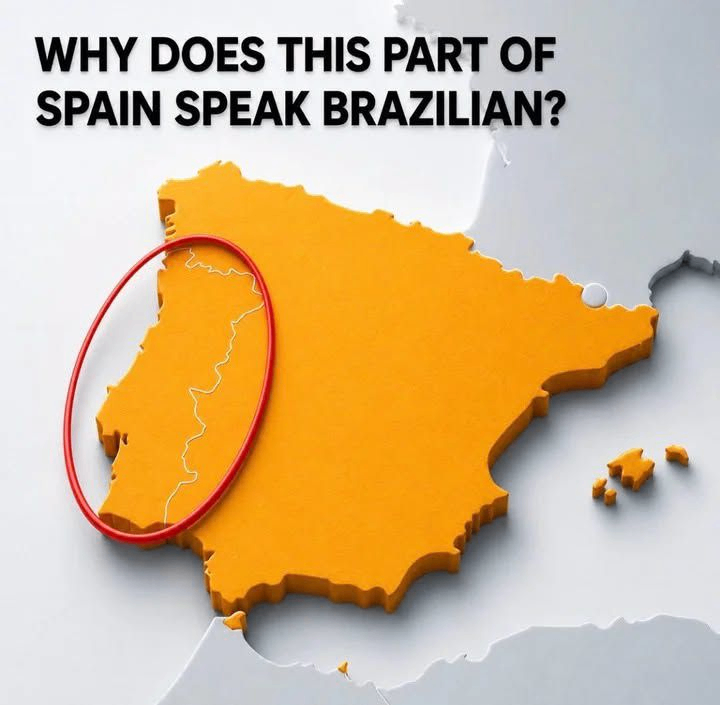
And in the south of Spain, they speak American. Super weird.
Why do they speak “Brazilian” in Portugal? Same reason people in England speak “American”, obviously. Basic history took the day off, I see. 😅
🇺🇸 English
😂
“Brazilian” isn’t a language, just like “American” isn’t a language. Brazil speaks Portuguese, and the US speaks English. Nice try, though.
I’m not “trying” anything. I’ve encountered a lot of websites with Choose Your Language dropdowns where English is represented by Old Glory and not the Union Jack.
Fair enough — many websites do use the US flag as shorthand for English, even though it is technically inaccurate. My point was only that “Brazilian” is not the name of a language: Brazil speaks Portuguese, just as the US speaks English.
🇧🇷 Portuguese.
Maybe it has something to do with the giant red rubber band surrounding it
I assure you they don’t speak Brazilian.
Old Brazillian
International Brazilian may be a better name. Several countries speak a language similar to it.
Macauan-Angolan
Ah, yes, the Brazillian Guiana.