

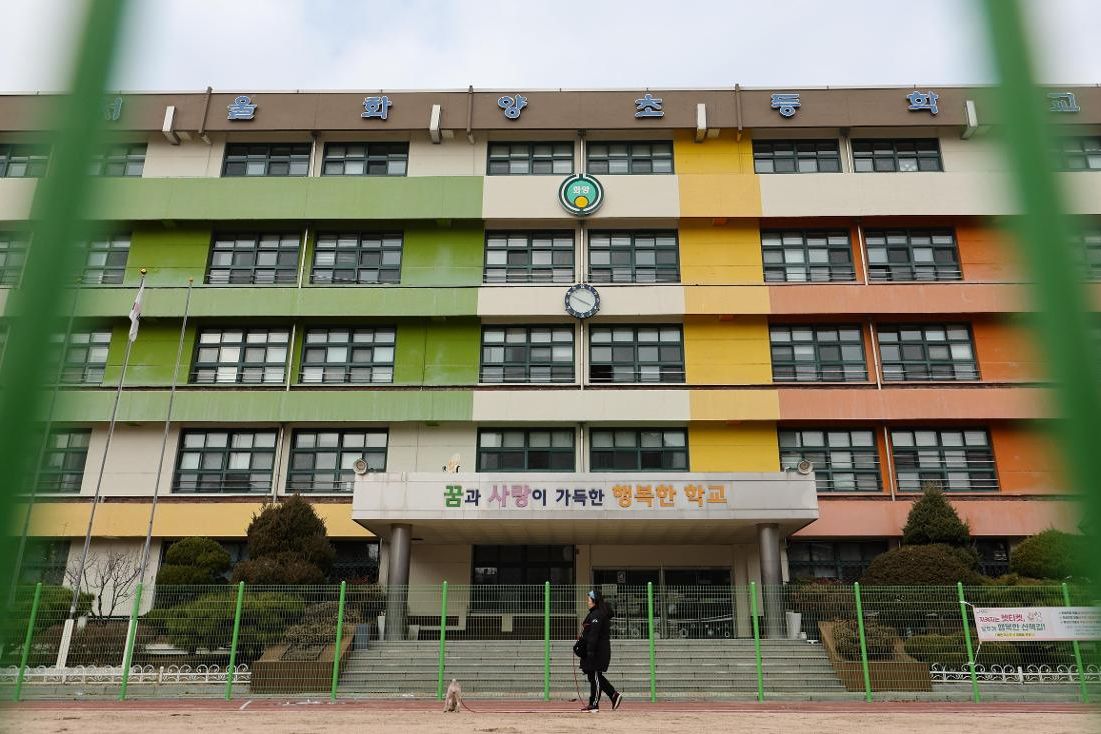
More than 4,000 elementary, middle and high schools across Korea have shut their doors as the country’s student population shrinks, new data shows.
According to the Ministry of Education’s latest figures, revealed on Sunday by Rep. Jin Sun-mee of the ruling Democratic Party of Korea, since 1980, 4,008 schools under 17 regional education offices nationwide have closed as of March this year. During the period, the number of enrolled students decreased from 9.9 million to 5.07 million.
That’s half the student in 45 years!
Meaning it’s getting even worse!!
These numbers are insane, I’ve heard that South Korea is working like crazy to make robots that can help lift the burden of taking care of the elderly. But I wasn’t aware it was this bad!!
let’s not make value judgements like, i don’t like children until they have personalities and mortgages and my wife is an elementary school teacher. it takes all types in this world.
I don’t think you understand the problem, because lower is absolutely worse. A small decline in population is fine, the world probably has too many people already. But a steep decline like this is catastrophic for a country.
The fertility rate required to maintain population is around 2.1, having it at only 0.8 is really bad, making the South Korean population basically on a path to extinction within a few hundred years.
dude my degrees are better than your degrees in the subject but try to go off. “a steep decline like this is catastrophic for a country” no it isn’t, we want to believe it would be but the only steep population declines we’ve ever actually seen were from famine, war the like. Just because you read a book with a funny title does not give you an understanding of the choices people voluntarily make and that does not push a country to a cliff.
Funny then how your previous comment is completely disconnected from the real problem.
I think I’ll just block you, because you are too weird for me.
They have the lowest birth rates in the world, beating Japan by some margin. Since most of the world is heading that direction, is important to watch how these countries handle the issue, so we can prepare better
I think it has a very simple explanation, but I doubt many people will agree with me.
I think it proves that humans simply do not have an inherent urge to procreate. Humans have the urge to have sex, sure, and for a long time having sex carried the consequence of having children, but they are not the same thing. When people are able to survive without children and have the CHOICE to not have children, many simply don’t want to.
In the past people needed many children, because many of them died before adulthood, and they needed the rest to take care of them in old age. Women didn’t have the right to say no and many needed husbands to provide for them, since they couldn’t own their own property or even have jobs. When men wanted sex, women had to comply and without birth control they automatically got pregnant, whether they wanted to or not.
I think not having the option to choose, people had children because… that’s just the way it was.
Now people have a choice. And we see what choices they make.
I’m sure many people are going to argue that it is too expensive to have kids, but let’s be honest here. Most humans on earth today are orders of magnitude more prosperous than 400 years ago, for example. If people really wanted kids, they’d have them.
Many people simply don’t want kids and maybe it’s time we finally acknowledge it.
There are only a few groups of people who still have lots of children: the very poor in underdeveloped countries and the very religious. And note that in many of these cases people don’t really have a choice.
Or people just can’t afford to have them. Or they don’t have reliable access to childcare. Or they are too afraid of the future to subject chuldren to whatever is coming. Or any number of social issue that could be fixed.
Housing used to be cheap enough that you could just have enough to have a family and without worrying about space, now housing yourself is a burden because we’re forced to subsidize the lifestyles of the super rich
Fucking nailed it.
SK is not going to be a good example because, in addition to the usual reasons for a declining birth rate, they also have some pretty extreme racism, sexism, and a work culture that even worse than Japan in many ways. Why would you want to have kids in South Korea‽
Let’s say you do have a wife and kids… Good luck getting home to see them on time on the regular!
What’s incredible is that the government’s stance on this situation is that it is preserving their culture. What they really mean is that they’re keeping out foreigners and not cross-breeding with the riffraff (which is… The rest of the world).
They will “preserve” themselves right into extinction.
I think that there will be a revolution that completely upsets things like work life balance and housing costs and whatnot and only after the economy suffers a severe depression from the population this match, forcing the issue against their will
There’s a reputation amongst the air force that if you’re deployed to korea you’ll come back married to a local, they really don’t want to live in korea
Yeah, if anything they should only be looked to as examples. Then do the exact opposite lol
Most other countries do their best to create environments that are hostile to children, but in a different way.
I basically agree. It’s hostile to be one and it’s not particularly friendly to afford one either. Half my friend group lives with their parents still because I’m getting a job won’t let them afford a place to live, which is an absurd statement but also just true.
And hardline anti immigration.
Many of them think preserving their culture is more important (or dignified) than extinction.
Don’t forget who’s their neighbour. North Korea might win without shooting a single bullet.
It would be pretty wild if the Korean reunification was accomplished due to the complete demographic collapse of South Korea.
Though, NK isn’t doing that much better, coming in with a fertility rate somewhere between 1.3 and 1.4, which is somewhat unusual when compared to other countries with extreme poverty.
The population of North Korea is approximately 26.5 million while South Korea is around 51.7 million. North Korea has already overtaken the South in total number of births per year (~340,000 VS ~250,000 in the South).
If the current trend continues (which I doubt it will), that means North Korea’s population will overtake South Korea some time around 2090-2100.
Instead, what’s going to happen is South Korea will have a regime collapse and then they’re going to have a “come to Korea” moment (like a “come to Jesus” moment, but Korean-themed and much more literal). There’s all sorts of things they can do to improve their situation practically overnight (from a geopolitical perspective) but they’ve so far refused to do so (for racist reasons).
Either they’re going to fortify their population with foreign stock or they’re going to demonstrate “the superiority of the Korean race” by going extinct.
With countries as homogenous as Japan and South Korea, I don’t see racism having a statistically significant effect
Sexism is an issue in both cultures, but if that is a major factor why is Japan’s fertility rate right between Spain and Finland?
Work culture in South Korea is certainly problematic, although I would again bring up Spain and Finland. I would also note Japan’s work culture has had a massive shift over the past couple decades. The average Japanese worker works far fewer hours than the average American worker, and fewer than the OECD average. The '90s stereotypes about Japanese work culture are no longer true
Here’s a better question: Why would you want to have kids in North Korea?
The fertility rate in the north is more than double the South, but here’s a more interesting fact: The birthrate in the North has been steadily declining for decades in almost lockstep with the South (note: there is a bit of wonkiness with a couple years in both data sources. Ignore the outliers), just at a slightly slower pace
I used this site to compare country pairs. With the Koreas you can see shared inflection points, such as in 1981, and a general trend line that looks the same
Then compare Russia and Ukraine. A much more volatile fertility rate. In 1986/1987, both countries share a local maximum, followed by a very sharp decline that continues until a local minimum right around 2000. We don’t see this pattern with the others (although they all seem to follow the same trend)
Finally you have the US and Canada. Shared local maximum in 1990/1991, and again in 2008. Both closely follow each other in terms of fertility rate inflection points, but not at the some times as other pairs
Also of note: All the lowest fertility rate countries (South Korea, Taiwan, and China) are geographically near each other, with very similar primary industries - high-tech manufacturing
My hypothesis: The most important factor is environmental. Likely an air pollutant of some kind (maybe several kinds)
I don’t have much evidence for this other than correlated fertility rates, but it’s the only thing I can think of that fits the data
Pollution would make sense if people were trying to have kids but couldn’t. But they’re not trying to have kids at all!
The more likely explanation—related to tech—is that we don’t need kids anymore. For 99% of human history, children were necessary and not having kids was basically impossible (horny kids and no birth control). Kids were how humans kept alive/stable as well as expanded their power and influence! It’s also how they got cared for in old age (though that’s a much lesser concern because I seriously doubt humans of the past thought that hard about such things when living to 40 was considered amazing).
Now we have birrh control and—in Western societies—stability/safety is much more likely if you don’t have kids. We’ve basically flipped the script on our evolution.
You want people to have kids? Flip the script back! Make anyone under 30 without kids pay a massive tax that pays for the kids of people who have them! Basically, make everyone who didn’t have kids pay child support.
Make having kids the best damned economic decision anyone can make with diminishing returns after two (kids).
Consider that there might not be a single unifying explaination and instead a number of compounding factors.
Japan was the first to have a fertility crisis, but they’ve slowed the issue a lot. Spain and Italy, for example, now have a lower fertility rate than Japan
I find fertility rate to be such a fascinating topic, because there is no simple explanation, although many people will suggest simple explanations
I’ve heard it’s because of the cost of housing, but Japan fixed their housing crisis decades ago, and South Korea never had much of one, at least not compared to Canada, New Zealand, or the US
I’ve heard it’s about how women are treated culturally, but then why would the fertility rate in places like Norway and Finland be dropping so dramatically?
And I’ve heard it’s a reaction to dystopic late-stage capitalism, but then why is the fertility rate dropping so rapidly in North Korea?
The general explanation of difficult economic conditions doesn’t seem to hold up when you look at a place like the Korean peninsula. There was a great famine in North Korea during the '90s - the arduous march - where millions died in only a couple years. The fertility rate remained far higher during that than it is now. South Korea had far worse economic conditions than it has now, but had a far higher fertility rate
My hypothesis is that it’s related to some form of pollution. Obviously there are many contributing factors, but it’s interesting to me that the lowest birth rates are all in countries around major manufacturing; especially technology manufacturing. South Korea, Taiwan, and China all have the lowest birth rates in the world. Many European countries like Spain and Italy aren’t far behind. Both areas have the highest concentration of high-tech manufacturing
The kinds of fixes that could work are the kind that would be expensive and beneficial to workers, which is why it’s not done. The police angle doesn’t make much sense because it’s not like it’s caused by people who are trying and failing to have kids, except for people who only start in the 40s because that’s how long it takes to become an economically self-sufficient enough to do so. Any government that wants to replace needs to make having a family-sized home and a decent work life balance readily achievable to any 25-year-old
It’s really simple: kids are a chore. Once you remove the economic and social pressure to have kids most people will opt out of the experience and do more interesting things instead. In developing countries economic pressure exists (kids support parents when they are old) but in developed countries only social pressure is left. Once it becomes socially acceptable not to have kids people just stop. In some countries like France kids are still a status symbol so people try to have 2 kids. In other countries kids are used mostly for socializing: when all your friends become parents it’s hard to hang out with them without kids because all gatherings become kid parties. Most couple have one kid because that’s enough to be included. But as more people don’t have kids it’s easier to find friends without kids to do things together and another motivation is gone. There was also a pretty big shift in how people approach childless couples. Asking “when will you have kids” is becoming a faux pas because people are more aware of fertility issues so another source of social pressure is gone. The truth is that even in perfect financial situation few people will have more then 2 kids (just look at the stats). In less than perfect situation people decide to have 1 or 0.
Possibly some form of 100th monkey effect? Except instead of skill sharing, it’s more emotion based? Most of the world seems to be in a sort of despair, when there is so much despair, maybe it spreads like wildfire whether you realize it or not?
It’s a neoliberal myth that your society needs to constantly be growing…ie there need to be more younger people than older people.