
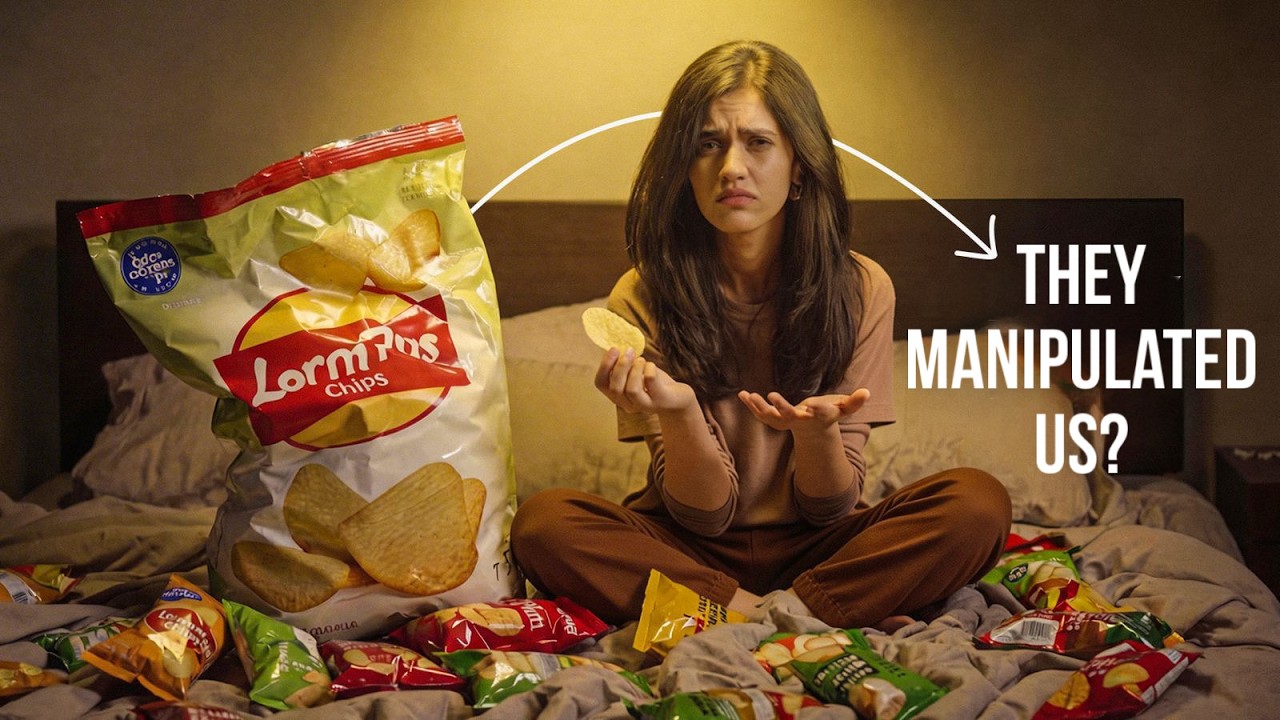
Food engineering has grown to the point where food is treated as “products”. Taste, feel and looks are highly engineered to optimize our sensations.
Looks: Marketing of food products use wildly unrelated items (glue to mimic cheese, shoe polish to mimic seared meat) to make the food look appetizing. This sets up for completely unrealistic standards.
Taste: Sugar has been pushed in our diet under different names (dextrose, fructose, corn syrup). Salt has been optimized to excite our senses. But the proportion is carefully controlled to ensure we never feel overwhelmed or saturated with a particular taste.
Feel: Food companies hire the best engineers to optimize surface characteristics to ensure their ‘products’ has great sound, great texture and so on. Pringles famously worked on double curvature for specific mechanics.
These food companies have created ‘products’ that are extremely far from nature. They are engineered heavily to maximize profits at the cost of consumers health.
What can you do:
-
Read labels: Most countries have food regulatory bodies that require companies to publish their nutrition info. Check the “daily value” information. Check the “serving size”. DO NOT TRUST WHAT IS PRINTED ON THE FRONT. The real info is always in the back in a boring black and white table.
-
Spread awareness: Companies are betting on the fact that you are too tired, too occupied or too ignorant to care about all this. I understand you may have bigger problems. But always remember that you may have 1000 worries but when you have a health issue you only have 1 worry.
-
Reach out: If you struggle with food addiction and over consumption don’t struggle alone. This battle cannot be won alone. You are fighting against an army. Join local support groups. Help yourselves to gather allies. If you know know someone who is struggling, reach out and help. Any food that you make at home ( no matter what you make) cannot possibly be as unhealthy as ultra processed crap.
There is some good information in here, but it’s also mixed in with some bad.
I don’t have the energy to go through it all. But for just one tiny example: Parmesan cheese and cellulose. First of all, bad information says “cellulose is what you find in wood. You’re eating wood!” Yes, cellulose is in wood. It’s also in VEGETABLES. If you eat vegetables, you’re eating cellulose. Furthermore, it’s a small percentage of the grated parmesan cheese, and it’s there to prevent the cheese from caking and clumping. This video claims [approximate quote] “There’s hardly any cheese in parmesan cheese” which is a bullshit claim. It’s usually like 95% cheese, if not more.
Just one example.
And yes, there is some good information in here.
But also, regarding being able to pronounce ingredients: Look up what makes up an apple. It’s chemicals you can’t pronounce. And yet apples are most certainly healthy.
This video is really not a great source of information. Marginal at best. I think they were trying, and there is some good info in there. But it’s mixed in with some pretty marginal info.
Reading the labels helps avoid the truly shitty makers. There was a brand of fake parmesan cheese that got outed for having higher than 45% filler in their grated Parmesan cheese. 50% of the filler was the cellulose powder.
The worst offenders are NOT a small percentage. It’s usually easy to notice because it’s so much cheaper than the rest on the shelf but not always
Iirc they called them bulking agents in the article I rememebered
apples are going to be labeled: apples, on a nutrition facts list, not by its chemical name.
I mean the basic rules apply: If it’s in a box/in the center part of the store, it should only be used occasionally.
Doesn’t apply outside the US.
It absolutely does, just to a somewhat lesser degree.
Food is the most insidious drug there is. The above is also true for heroin, crack, cigarettes, and a bunch of other things, but yet many people cannot help themselves even when they know it’s bad. Food is by far the worst, most available one, with decades and likely trillions of dollars of research and optimization you have to fight your most base urges against. Almost everyone succumbs, and out of those only a small number can self-moderate, and out of those only a few are fine.
Gotta stick as much as possible to minimally-processed food when shopping. As a general rule, nearly anything you make yourself is going to be healthier than the processed version sold in the store.
most food you cook at home is gonna be processed through heat, chopping, washing and rinsing anyways. you can’t retain a healthy diet if you eliminate processed foods, mostly because a lot of unprocessed ingredients are unsafe to consume
Are you purposefully misunderstanding that comment?
no, I’m just trying to demonstrate how the popsci view of processed foods as bad is unscientific. we’re not cows, we need processed foods to survive and we evolved as a species to live as such
‘Processed food’ usually refers to industrial processes often requiring different ingredients or production stepa compared to homecooked
Eg. Homecooked soup Vs. Instant package soup.
Both are soup, but homecook has usually less salt, less sugar, less preservatives, kcal and shorter cooking times for the ingredients.
That’s why ‘avoid processes food’ is such common advice.
if someone can only afford to survive on instant soup then they have bigger health problems to worry about such as poverty and risk of homelessness. aka social determinants of health. framing it as a diet issue when your diet is shaped by what your class affords you to buy is asinine IMHO
When I was poor poor I would just eat canned veg and apples. I could shit really really fast.
lmao fiber tornado
The idea is you process the food yourself via cooking it at home versus the food being processed at a factory and subjected to the engineering described in the original post: addition of preservatives, excess salt and sugar, etc.
what peer reviewed source can you provide that says preservatives are harmful?
“preservatives” are not inherently unhealthy. But some specific ones are, depending on dose, quite bad for you.
Salt is a pretty preservative, as is sugar, citric acid, vinegar, etc. You can eat those in pretty huge (for additives) quantities before you notice anything.
Other stuff, like BHA/E-320 is banned from EU babyfood becuase it’s very low dayly limit (.5mg/kg) is a risk for babies. If you’re the kind of person who snacks on cereal all day, you’re absolutely in the risk group for it. Sodium Nitrate/Nitrite is not dangerous most of the time, but if you’re eating lots of beef jerky, that can absolutely form a cancer risk increase (It’s in IARC group 2A)
Of course, you can construct argument like this for pretty much every substance in food. The main difference is that some are entirely avoidable.
Agree we should be aware of what we’re consuming. Think the rise in certain diseases is correlated to diet and gut health. Lack of fiber, too many preservatives/sugar/etc. is getting more common in modern diets.
IMO it’s the convenience factor you have to try to overcome in most cases.
Some practical things we’ve been doing is buying more produce locally. We go to a weekly farmers market nearby or shop the perimeter of the grocery store only and avoid the center aisles. The trick is to use what you get before it goes bad (which natural food should, it’s a red flag to me if food is shelf stable for months). So we got a slow cooker and now it’s pretty easy to throw a bunch of vegetables in and have dinner ready without much effort or clean up.
The other trick is to just not have snacks in the house, otherwise we’ll end up eating those pretty quickly. I love potato chips, but if we don’t buy them, I don’t miss them and end up eating fruits or something else.
It’s a win-win, because it’s relatively cheap (beans and rice is cheaper than packs of ramen) and healthier.
But yeah it’s an uphill battle and getting increasingly difficult and more expensive to find food that’s good for you unfortunately.
It’s just very tiring not being able to trust anything. It feels like every company is out there to get you
Agreed and when you find a small, indie company making good stuff, they may get bought by a megacorp who ends up worsening the product.
From what I can tell, a Certified B corp label seems to be a decent indicator of meeting at least a minimum standard of ethics. Hopefully more businesses start to put people of profits.
Mostly they’re out there for profits. Your health simply isn’t a consideration.
Sadly you can’t trust this video either.
You can download an app called Yuka which will tell you if a food or cosmetic product has anything suspected of being bad for you in it.
The app suggests alternatives but you have to be careful (it suggested a lot of zero-fluoride tooth pastes which would make my teeth rot)
For US consumers, Yuka will tell you if an ingredient is banned in the EU or Australia or regulated there in a different way.
I use a zero fluoride toothpaste, and have no dental caries.
I still believe in science and that fluoride is better at preventing cavities than just the abrasion from the paste.
Unfluoridated toothpaste is a very good idea if you live somewhere with water fluoridation, or naturally high fluoride levels.
deleted by creator
That’s my philosophy. The more unprocessed, whole, plant based, the better.
Fruit Juice Concentrate of any kind is also sugar.
I’m so done arguing with people who say: it’s the good kind of sugar. It has as much sugar as a cola. The thing most parents wouldn’t give their children.
There is obviously difference between eating an apple, and drinking apple juice. The juice has more sugar, no fiber. The apple itself is fine, as there is fiber to offset the sugars, sugars that have not been concentrated into juice. Juice is unhealthy, whole fruit is okay imo.
Lately, I have been buying less from the corporate grocery store in my neighborhood and more locally produced foods. When I do go to the store, I’m picky about what I buy. Even so, a lot of the food sold here in the US is still toxic. For example, I’ve been buying imported Italian flour, because grains grown here are soaked in glyphosate. There is even research suggesting gluten allergies could actually be due to glyphosate: https://pmc.ncbi.nlm.nih.gov/articles/PMC3945755/
I fully support this! Buying from local store is always better in terms of both quality as well as human connection.
I have been buying Italian flour for years now!
I… I can’t afford it anymore. Fuck the US and fuck tariffs. I just used the last of my Caputo flour in the muffins I posted the other day. I am so upset about it. Been thinking of buying it in bulk bulk. I found 55pounds for $70, any smaller quanity, the price sky rockets.
Ask yourself is it kosher? What exactly does that mean?
In Judaism, it has to do with their insane Kashrut laws. Kashrut only applies to meat that’s clean or unclean, not some stupid rituals.
Kosher is a Jewish custom. It’s a set of rules for food. To put is vaugly, meat and dairy cannot touch (even the same cookware) at any point in a meal.
deleted by creator
Damn, I miss making bread. Just seeing the title makes me want to restart my sourdough culture
What stopped you?
Bad body lol.
Between arthritis, a deteriorating back, and the extra clean-up and work involved in maintaining bread making (be it sourdough or with commercial yeast), it was just too many spoons.
I keep hoping my household will settle down enough that I have the inner and physical resources to get back to it though! There’s so much peace in the process.
Ive been making this:
https://www.kingarthurbaking.com/recipes/pan-de-cristal-recipe
I like it because there is no kneeding. none, first time it was a lot of reading the how to, but its so easy, out side of setting 20 min timers 4 times. I dont even devide it. Bake it whole for 45 mins.
I have an idea! I know it won’t be quite the same as what you were doing before, but there is a way to make this easier.
What I do is use an automatic bread machine with a nonstick bucket. Instead of sourdough, I make multigrain bread. I just measure and add in the ingredients, turn it on, add the seeds when prompted, then take it out when it’s done. Currently I’m making whole grain bread and experimenting with various ratios of oat/dark rye flour, flax meal, and chia seeds.
Cleaning isn’t too hard, since the bucket is nonstick. I spray some dawn powerwash, wait about a minute, then fill the bucket with hot water, and let it soak overnight. When I clan it the next day, it comes right off. I usually wash the measuring cups/spoons about that time too.
It doesn’t use a ton of energy, and is manageable with both carpal tunnel syndrome, and ADHD/depression. Plus it’s very nourishing, and gives a small boost in overall energy.