

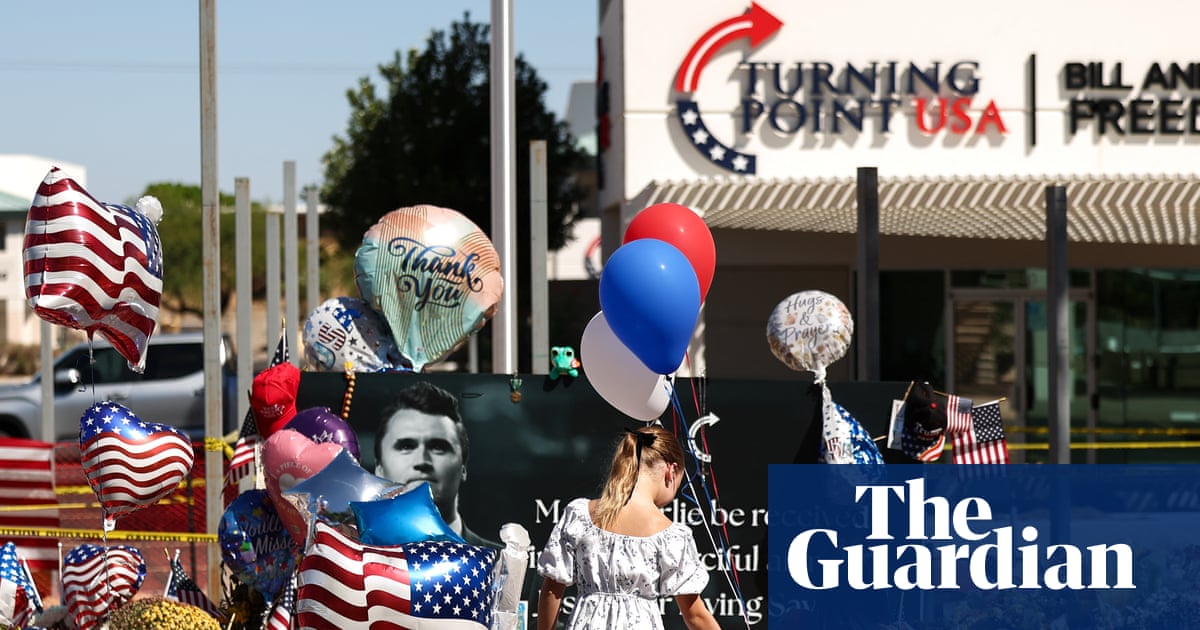
An analysis from the federal Bureau of Alcohol, Tobacco, Firearms and Explosive (ATF) could not conclusively connect a bullet fragment recovered during Charlie Kirk’s autopsy to the rifle found near the scene of the rightwing political activist’s killing – and the FBI is running additional tests, lawyers for Kirk’s accused murderer said in recent court filings.
In the court filings, Tyler Robinson’s defense team also asked for a delay to a preliminary hearing scheduled in May, saying they need time to review the bullet analysis as well as an enormous amount of other material that could contribute to the suspect’s defense.
The ATF’s bullet analysis report has been kept private, but attorneys have cited snippets in other public filings that say the results were inconclusive.
The defense said in its motion that it may try to use the analysis to clear Robinson of blame during the preliminary hearing while prosecutors aim to show they have enough evidence against him to proceed with a trial.
Same with fingerprinting and blood spatter analysis. There is very little within the field of forensics that is backed by science. Fingerprints are not admissible evidence in many courts.
“We’re 100% certain the one responsible for destroying the eucalyptus bush is either you or this koala. Why don’t you just admit it now and save yourself some trouble?”
*munches on leaves*
It was the koala!
Eats shoots and leaves!
gangster koala
The sinister panda that has been lurking around the scene of the crime chuckles to itself and capers off.
have you not heard what terrible beings koalas are?
There are points of similarity in fingerprinting, and every state has their own number of points to be a match. They all accept them as evidence.
You mean they bring in an “expert” to testify that the fingerprints match… and when you give 2 “experts” the same set of fingerprints to compare, they literally come to disagreeing conclusions in 50% of tests
It is not a scientific or analytical process with scientifically identified “points of similarity”, its just a person who is deemed an “expert”, who looks at 2 fingerprints and says “yeah these look similar, and they look similar in X different places so 👍”
There are the actual standards, then there are prosecutors perverting them. Prosecutors are the least trustworthy people on the planet. Total pieces of shit, no argument here. But fingerprints themselves aren’t junk science as I’ve read, not like past hair analysis, blood spatter, bite mark analysis, 911 voice recording analysis, or any number of other junk sciences. As I understand it.
But don’t let me dismiss your point out of hand, what gave you this opinion, did you read something as such, you have a source on this?
I searched and couldn’t find any information about fingerprints not being admissible in any courts. I’ve found a lot of stories about how they aren’t 100% accurate (closer to 95-99 percent), but not one story about how fingerprints were not admissible.
Where are these “many courts” that don’t accept fingerprints?
Did you try?
https://science.psu.edu/news/barriers-use-fingerprint-evidence-court-unlocked-statistical-model
Fingeprints are not admissable, just some guy’s opinion, because fingerprint identification has no real basis in science. Science is not based purely on someone’s opinion. And no, they aren’t 95-99% accurate (especially because it is just some guy eyeballing it), when tested by giving multiple “experts” the same set of prints, the “experts” come to disagreeing conclusions about if the prints match or not over half the time.
Oh, come on. You’re just being pedantic. Fingerprints are allowed as evidence in probably every court in the world, as long as they have been reviewed by an expert. Yes, technically it is the expert’s testimony that is the evidence, but that is the case with most “evidence.” Prosecutors don’t just show the jurors a medical chart and tell them to interpret that evidence. They have a doctor give testimony on why that medical chart means X, Y, and Z.
(https://pmc.ncbi.nlm.nih.gov/articles/PMC4008377/)
8% false negative and 0.1% false positive… so 92% accurate in that study. Just slightly better than your “half the time.”
https://www.nist.gov/news-events/news/2020/05/nist-study-measures-performance-accuracy-contactless-fingerprinting-tech
Computers can achieve 60% accuracy with contact-less scanning and 99.5% with contact scanning. A phone app can get 95% accuracy. Again, somewhat better than your “half the time.”
https://nij.ojp.gov/topics/articles/history-and-legacy-latent-fingerprint-black-box-study
7.5% false negative and 0.1% false positive.
https://www.uclalawreview.org/reliable-application-of-fingerprint-evidence/
FBI study showed 99.7% accuracy, and Miami Police study showed 95% accuracy.
Partial prints are much less accurate than full prints, but to say that fingerprint analysis is so inaccurate that it isn’t allowed in many courts is disingenuous. Expert testimony on fingerprint analysis is allowed in every court, which is what a normal person would mean when they say fingerprints are allowed as evidence.
I seem to recall that the debate is more about partial prints, which are often all that’s found at a scene. A “100% match” of a small part of a print isn’t the same as a 100% match to the whole print. And even full prints can be of varying quality: the print can be smeared to varying degrees, or on a substrate that allows for diffusion of the print once it’s made (e.g, an oily surface).
not anymore fingerprinting, a study came out recently how fingerprints can be very similar to one or another