My parents did a lot to model being smart with money and only one of their kids (me) picked up on it. Kids often love being the opposite of what they’re taught, no matter how much it hurts them.
The thing about people who buy NFTs is that they think they are being smart with their money.
They look at what happened with Apple, Microsoft, Google stocks way back in the day and think “huhuhu, I’m not going to be one of those idiots who misses out on an opportunity like that!”
It’s FOMO and “high risk - high reward” gambler mentality, wrapped up in the illusion of being a savvy investor.
Sure, that’s true. I think in mine and many cases, wrapped up in the “being smart with money” lesson is saving, mitigating risk, and decreasing spending where possible. I at least hope most parents (who bother at all) are defining what being smart actually looks like.
Yes but some financial advisors will literally tell you that money in savings is slowly decaying and that (besides an emergency fund) you should invest it.
The type of investments they’ll recommend will depend on your risk tolerance and financial goals of course, and probably isn’t likely to include NFTs.
But I could see some 19-20 year old reading a post on instagram that says you should invest instead of saving, and with a very superficial understanding of what that actually means, might easily fall for the very next post or sponsored ad that says “Hey you! Yeah, you. The dumbass who hasn’t bought [inset memecoin here] yet. Why don’t you have any [memecoin]?!? Anyone who’s smart has some already, and look how rich they’re getting! Don’t miss out by being a coward. Own your future. Grindset. Yadda yadda.”
I’m not saying that makes them intelligent, but simply telling them to be “smarter with money” isn’t going to solve the problem, and might actually exacerbate it.
Just telling them to be smart with money is not what I’m talking about though. What I’m talking about is actually modelling and teaching some amount of knowledge about how to save.
Because of course you can’t expect a child to learn a bunch of vital and complex stuff when you don’t attempt to help them. My original reply here was concerning people who actually had been taught something, rather than those who heard some useless vague advice in passing.
I see. That makes sense. Sometimes I forget that some people actually grew up with effective parenting.
Finances were one of many taboo topics in my house growing up. I never even knew a remote approximation of my dad’s salary, or what things like groceries, utilities, healthcare, etc. cost; until I became an adult and had to face those things for myself. I felt pretty blindsided by how expensive life is.
When I was a kid my parents gave me three envelopes and said one’s for saving, one’s for giving to church, and the other’s for spending. Or at least they claimed they told me that, a year later when they found out I was putting all my allowance in the same envelope. But that’s the first I recall ever hearing about their little system.
After that, there was no oversight. No checking in or auditing to make sure I’m doing it right, no instructive moments when they found out I’m doing it wrong. Just scolding and blaming, and shortly after I stopped receiving an allowance because it “wasn’t working” to teach me financial responsibility. As if all it takes is saying “do this” one time and then forgetting it.
It was the same with everything. Hygiene, chores, etc. They thought they could tell a kid with single-digit age “do this” one time and then forget about it and assume it immediately becomes a failproof habit. And then scolding and blaming when years down the line they find out that’s not the case. “I taught you better than this! You’re just being lazy!” Stuff like that.
It’s a foolproof way to instill something: oppositional defiant disorder.
So yeah, sometimes I forget that to some people “parents taught me [such and such] good habit” actually means “modeling good behavior and checking in to verify and make gentle corrections until it actually becomes learned.”
Thanks for this response. I do think our parents were more similar than you’d think. And I hadn’t really examined what I was taught about money as closely as you. I was never taught in anything in a systematic way, it was more like thousands of little interactions about saving money (because we “couldn’t afford” something I wanted, often; or if it was my money, what about things I wanted later?) and also just always knowing we were struggling financially.
For me, it was more than enough to think twice about spending large amounts. Then over the years I combined that sort of thinking with specific saving strategies I taught myself. For me, the constant barrage of recommending I save my money, or that we couldn’t afford something, or that we had to help my dad make some extra money, was enough to make me think about it all before going hog wild. Then I built up an untenable credit card balance in my early twenties and that was a wake up call too. I felt I knew better, so I swore off spending money I didn’t have unless I “had to”.
My siblings though? They didn’t learn shit. They blow most of their money on whatever and afaik they are both still in debt. Every time they get unexpected money they see it as free money to spend. Maybe I should blame my parents more, because they needed more/different guidance? It also doesn’t help them that my parents bail them out financially every couple of years.
Your parents sound eerily like mine though in some ways. A core memory I have is when I was probably about ten I was handed a paintbrush and told to paint my closet. I started about doing it without any instruction whatsoever and was scolded for doing it wrong! I responded that I literally had no idea what I was doing, they didn’t teach me, and only at that point did they teach me to use a paintbrush. But it was like you say, reactive to doing it wrong and nothing proactive at all… I don’t understand how I came out as functional as I did. Because they too did a lot of teaching the lazy way, tell you nothing ahead of time and then get mad when you didn’t know…
That’s pretty much FOMO though. They thought I was the next big thing, *and* they didn’t want to miss out on it.
And it doesn’t matter if it’s really investing or not, because the fact remains that the people who buy it believe that it is. If they didn’t think of it as an investment, they would have zero reason to buy NFTs (unless they intend to use it on the dark web)
If that’s FOMO then pretty much every decision could be considered FOMO. I decided to put my shoes on this morning because I was worried everyone else wearing shoes would enjoy the advantages there-of and I would miss out.
That’s funny because I actually didn’t wear shoes today cause I was having FOMO about that barefoot life after listening to Shakira sing Pies Descalzos
I was raised pretty middle-upper class. Only child. My dad made 6 figures. I had a lot of privilege growing up and I knew I did. I was well informed on family finances, investments, etc. We were also frugal(ish) in spending. We went camping every year which I loved, but very few things like vacations, new cars, etc. We had a modest house in a small town. My parents would always just have a shit ton of money saved in savings accounts or investments.
Fast forward to today, they helped my partner and I buy a small farm halfway across the country. We’re a single income house (my partner has disabilities that prevents them from working). We live paycheque to paycheque because we like spending money. Local farmers market, buying things for the farm, and I get a little money spendy because my parents never really did that. I learned all the tips and tricks growing up and once let loose I didn’t really care. Never did.
We’re financially okay. We have debt like everyone else, but it’s manageable. But we don’t save anything. We’re trying to now this past year but it’s slow because I work in town and my partner will want me to pick up this thing from Canadian Tire, or this from Home Hardware, and always needing new things, or upgrading things on the century old house and homestead.
Basically, I was raised with money and my parents didn’t spend a lot of it. They’re very well off now. I do the opposite. I don’t really care much about the future, as hopefully we can break even on the farm. But we are trying to live more in the now than my parents ever did. Financially, I am very different from my parents.


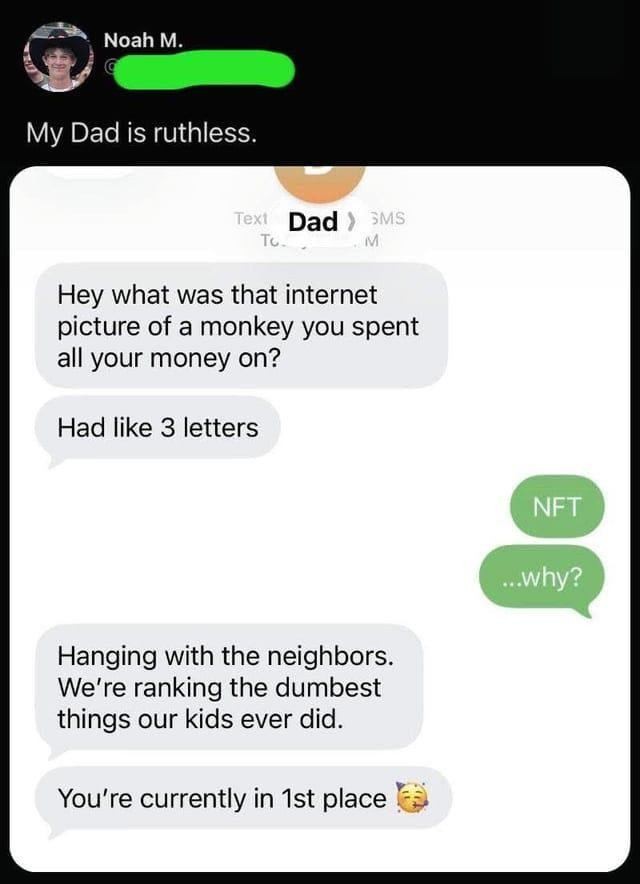
My parents did a lot to model being smart with money and only one of their kids (me) picked up on it. Kids often love being the opposite of what they’re taught, no matter how much it hurts them.
IDK how much parents “modelling” things really helps.
My parents fell for every scheme they encountered their entire lives.
Watching them taught me to be very critical of that kind of thing. I guess they did model what not to do.
Heh, I mean modeling can work in the intended way or by accident in the opposite way you’d expect. So yeah I’d say it worked for you :)
The thing about people who buy NFTs is that they think they are being smart with their money.
They look at what happened with Apple, Microsoft, Google stocks way back in the day and think “huhuhu, I’m not going to be one of those idiots who misses out on an opportunity like that!”
It’s FOMO and “high risk - high reward” gambler mentality, wrapped up in the illusion of being a savvy investor.
Sure, that’s true. I think in mine and many cases, wrapped up in the “being smart with money” lesson is saving, mitigating risk, and decreasing spending where possible. I at least hope most parents (who bother at all) are defining what being smart actually looks like.
Yes but some financial advisors will literally tell you that money in savings is slowly decaying and that (besides an emergency fund) you should invest it.
The type of investments they’ll recommend will depend on your risk tolerance and financial goals of course, and probably isn’t likely to include NFTs.
But I could see some 19-20 year old reading a post on instagram that says you should invest instead of saving, and with a very superficial understanding of what that actually means, might easily fall for the very next post or sponsored ad that says “Hey you! Yeah, you. The dumbass who hasn’t bought [inset memecoin here] yet. Why don’t you have any [memecoin]?!? Anyone who’s smart has some already, and look how rich they’re getting! Don’t miss out by being a coward. Own your future. Grindset. Yadda yadda.”
I’m not saying that makes them intelligent, but simply telling them to be “smarter with money” isn’t going to solve the problem, and might actually exacerbate it.
Just telling them to be smart with money is not what I’m talking about though. What I’m talking about is actually modelling and teaching some amount of knowledge about how to save.
Because of course you can’t expect a child to learn a bunch of vital and complex stuff when you don’t attempt to help them. My original reply here was concerning people who actually had been taught something, rather than those who heard some useless vague advice in passing.
I see. That makes sense. Sometimes I forget that some people actually grew up with effective parenting.
Finances were one of many taboo topics in my house growing up. I never even knew a remote approximation of my dad’s salary, or what things like groceries, utilities, healthcare, etc. cost; until I became an adult and had to face those things for myself. I felt pretty blindsided by how expensive life is.
When I was a kid my parents gave me three envelopes and said one’s for saving, one’s for giving to church, and the other’s for spending. Or at least they claimed they told me that, a year later when they found out I was putting all my allowance in the same envelope. But that’s the first I recall ever hearing about their little system.
After that, there was no oversight. No checking in or auditing to make sure I’m doing it right, no instructive moments when they found out I’m doing it wrong. Just scolding and blaming, and shortly after I stopped receiving an allowance because it “wasn’t working” to teach me financial responsibility. As if all it takes is saying “do this” one time and then forgetting it.
It was the same with everything. Hygiene, chores, etc. They thought they could tell a kid with single-digit age “do this” one time and then forget about it and assume it immediately becomes a failproof habit. And then scolding and blaming when years down the line they find out that’s not the case. “I taught you better than this! You’re just being lazy!” Stuff like that.
It’s a foolproof way to instill something: oppositional defiant disorder.
So yeah, sometimes I forget that to some people “parents taught me [such and such] good habit” actually means “modeling good behavior and checking in to verify and make gentle corrections until it actually becomes learned.”
Thanks for this response. I do think our parents were more similar than you’d think. And I hadn’t really examined what I was taught about money as closely as you. I was never taught in anything in a systematic way, it was more like thousands of little interactions about saving money (because we “couldn’t afford” something I wanted, often; or if it was my money, what about things I wanted later?) and also just always knowing we were struggling financially.
For me, it was more than enough to think twice about spending large amounts. Then over the years I combined that sort of thinking with specific saving strategies I taught myself. For me, the constant barrage of recommending I save my money, or that we couldn’t afford something, or that we had to help my dad make some extra money, was enough to make me think about it all before going hog wild. Then I built up an untenable credit card balance in my early twenties and that was a wake up call too. I felt I knew better, so I swore off spending money I didn’t have unless I “had to”.
My siblings though? They didn’t learn shit. They blow most of their money on whatever and afaik they are both still in debt. Every time they get unexpected money they see it as free money to spend. Maybe I should blame my parents more, because they needed more/different guidance? It also doesn’t help them that my parents bail them out financially every couple of years.
Your parents sound eerily like mine though in some ways. A core memory I have is when I was probably about ten I was handed a paintbrush and told to paint my closet. I started about doing it without any instruction whatsoever and was scolded for doing it wrong! I responded that I literally had no idea what I was doing, they didn’t teach me, and only at that point did they teach me to use a paintbrush. But it was like you say, reactive to doing it wrong and nothing proactive at all… I don’t understand how I came out as functional as I did. Because they too did a lot of teaching the lazy way, tell you nothing ahead of time and then get mad when you didn’t know…
No, I think with NFTs people were just looking at the bitcoin train they had missed out on, and thought NFTs would be the next big crypto thing.
Mostly they thought it was just the next big thing.
I think this unique. Not really FOMO and certainly not investing.
That’s pretty much FOMO though. They thought I was the next big thing, *and* they didn’t want to miss out on it.
And it doesn’t matter if it’s really investing or not, because the fact remains that the people who buy it believe that it is. If they didn’t think of it as an investment, they would have zero reason to buy NFTs
(unless they intend to use it on the dark web)If that’s FOMO then pretty much every decision could be considered FOMO. I decided to put my shoes on this morning because I was worried everyone else wearing shoes would enjoy the advantages there-of and I would miss out.
That’s funny because I actually didn’t wear shoes today cause I was having FOMO about that barefoot life after listening to Shakira sing Pies Descalzos
I was raised pretty middle-upper class. Only child. My dad made 6 figures. I had a lot of privilege growing up and I knew I did. I was well informed on family finances, investments, etc. We were also frugal(ish) in spending. We went camping every year which I loved, but very few things like vacations, new cars, etc. We had a modest house in a small town. My parents would always just have a shit ton of money saved in savings accounts or investments.
Fast forward to today, they helped my partner and I buy a small farm halfway across the country. We’re a single income house (my partner has disabilities that prevents them from working). We live paycheque to paycheque because we like spending money. Local farmers market, buying things for the farm, and I get a little money spendy because my parents never really did that. I learned all the tips and tricks growing up and once let loose I didn’t really care. Never did.
We’re financially okay. We have debt like everyone else, but it’s manageable. But we don’t save anything. We’re trying to now this past year but it’s slow because I work in town and my partner will want me to pick up this thing from Canadian Tire, or this from Home Hardware, and always needing new things, or upgrading things on the century old house and homestead.
Basically, I was raised with money and my parents didn’t spend a lot of it. They’re very well off now. I do the opposite. I don’t really care much about the future, as hopefully we can break even on the farm. But we are trying to live more in the now than my parents ever did. Financially, I am very different from my parents.