I don’t mind any of these approaches. Personally I’d want a single difficulty that is made challenging but with specific accessibility options. Like disable quick time events, loose lock on, and other things to make the interface more bearable if you have a physical or mental disability.
While I don’t care if a game has an easy mode, a lot of the “easy mode is accessibility” arguments feel similar to the “AI art is accessibility” arguments. Unless you can’t properly interface with the game, having low skill is not a disability or something needing accessibility support. If you practice you’ll get better at it.
The “but I don’t have much time” argument feels especially weird, like would you demand a cliff notes version of a book or TV show because you don’t have the time otherwise? If you just want the story just find a playthrough online.
If a game has an easy mode, great, it appeals to a wider audience. If it doesn’t, great, it’s catering to a specific audience. A game’s not worse for having an easy mode and a game’s not inaccessible for asking you to practice its mechanics.
If I buy a game for €50 and the game is too difficult for me to get past the tutorial, even with practice, I cannot access 90% of the game I paid for. You could call it catering to a small audience but it is different than a game like “pc building simulator” which also caters to a small audience that can at least be fully accessed by everyone (not considering impairments)
If there is no way of scaling down the difficulty then I would like a refund of the money I spent on content I could not access.
The ‘just watch a playthrough for the story’ argument doesn’t work for me. Games are a unique medium in a sense that the story is shaped by player decisions. Even if there is not a branching story, giving the player agency over small decisions like cosmetics makes the player more invested in the character and allow for roleplaying. That’s all lost when you watch someone else play the game.
I agree that if the difficulty is too high you ought to return it. Typically games are balanced for a sizable enough audience, if a game’s tutorial is impossibly difficult then it’s probably not a good tutorial or the game’s for a hyper niche audience.
I guess I can understand the appeal of easy modes just for experiencing the story. This does hit a wall though when a game’s story is dependent on its gameplay. Like Fromsoft games demand a lot of attention to understand the story beyond a basic level, they clearly want to gatekeep that and it’s part of their games’ identity.
My point is basically, difficulty is one of the tools a developer can use to craft their experience. While most games want to appeal to as many people as possible, it should be just as valid for a game to decide their experience requires inherent skill requirements, at the risk of people returning it if they aren’t the target audience.
The “but I don’t have much time” argument feels especially weird, like would you demand a cliff notes version of a book or TV show because you don’t have the time otherwise?
Sweet Summer child…
Yes, there are dummies like that. I remember reading about someone actually bragging about “reading more” by asking for book summaries via AI.


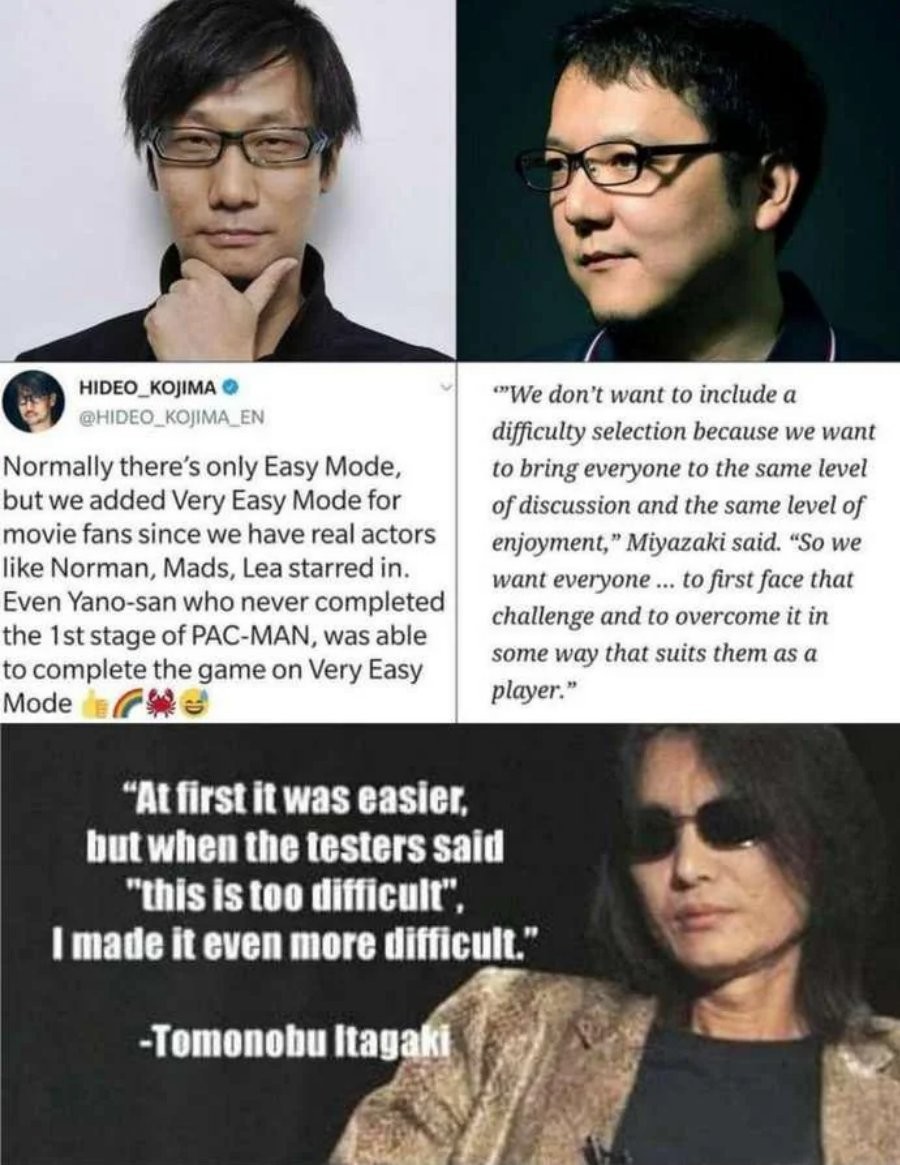
I don’t mind any of these approaches. Personally I’d want a single difficulty that is made challenging but with specific accessibility options. Like disable quick time events, loose lock on, and other things to make the interface more bearable if you have a physical or mental disability.
While I don’t care if a game has an easy mode, a lot of the “easy mode is accessibility” arguments feel similar to the “AI art is accessibility” arguments. Unless you can’t properly interface with the game, having low skill is not a disability or something needing accessibility support. If you practice you’ll get better at it.
The “but I don’t have much time” argument feels especially weird, like would you demand a cliff notes version of a book or TV show because you don’t have the time otherwise? If you just want the story just find a playthrough online.
If a game has an easy mode, great, it appeals to a wider audience. If it doesn’t, great, it’s catering to a specific audience. A game’s not worse for having an easy mode and a game’s not inaccessible for asking you to practice its mechanics.
If I buy a game for €50 and the game is too difficult for me to get past the tutorial, even with practice, I cannot access 90% of the game I paid for. You could call it catering to a small audience but it is different than a game like “pc building simulator” which also caters to a small audience that can at least be fully accessed by everyone (not considering impairments)
If there is no way of scaling down the difficulty then I would like a refund of the money I spent on content I could not access.
The ‘just watch a playthrough for the story’ argument doesn’t work for me. Games are a unique medium in a sense that the story is shaped by player decisions. Even if there is not a branching story, giving the player agency over small decisions like cosmetics makes the player more invested in the character and allow for roleplaying. That’s all lost when you watch someone else play the game.
I agree that if the difficulty is too high you ought to return it. Typically games are balanced for a sizable enough audience, if a game’s tutorial is impossibly difficult then it’s probably not a good tutorial or the game’s for a hyper niche audience.
I guess I can understand the appeal of easy modes just for experiencing the story. This does hit a wall though when a game’s story is dependent on its gameplay. Like Fromsoft games demand a lot of attention to understand the story beyond a basic level, they clearly want to gatekeep that and it’s part of their games’ identity.
My point is basically, difficulty is one of the tools a developer can use to craft their experience. While most games want to appeal to as many people as possible, it should be just as valid for a game to decide their experience requires inherent skill requirements, at the risk of people returning it if they aren’t the target audience.
Sweet Summer child…
Yes, there are dummies like that. I remember reading about someone actually bragging about “reading more” by asking for book summaries via AI.
Yeah I know about those services, though I wish I didn’t…