If something really needs to get done, like repairing necessary sewer systems, then it will get done, because it needs to. Do you really think that people who have the skills to repair the water treatment plant are going to just deal with sewage backing up into their home because they don’t want to do the work?
For a more comprehensive analysis of the question, I’d direct your attention towards an anarchist FAQ. I’ll quote a few choice sections below, but the link goes into great detail, comparing and contrasting multiple approaches to handling the problem.
There are some jobs that few, if any, would enjoy (for example, collecting rubbish, processing sewage, dangerous work, etc.). So how would an anarchist society deal with it?
[…]
It would be easy to imagine a free community sharing such tasks as fairly as possible between a community’s members by, for example, allocating a few days a month to all fit members of a community to do work which no one volunteers to do. This would soon ensure that it would be done, particularly if it were part of a festival or before a party. In this way, every one shares in the unpleasant as well as pleasant tasks (and, of course, minimises the time any one individual has to spend on it). Or, for tasks which are very popular, individuals would also have to do unpleasant tasks as well. In this way, popular and unpopular tasks could balance each other out. Or such tasks could be rotated randomly by lottery. The possibilities are many and, undoubtedly, a free people will try many different ones in different areas.
[…]
Of course, no system is perfect – we are sure that not everyone will be able to do the work they enjoy the most (this is also the case under capitalism, we may add). In an anarchist society every method of ensuring that individuals pursue the work they are interested in would be investigated. If a possible solution can be found, we are sure that it will. What a free society would make sure of was that neither the capitalist market redeveloped (which ensures that the majority are marginalised into wage slavery) or a state socialist “labour army” type allocation process developed (which would ensure that free socialism did not remain free or socialist for long).
In this manner, anarchism will be able to ensure the principle of voluntary labour and free association as well as making sure that unpleasant and unwanted “work” is done. Moreover, most anarchists are sure that in a free society such requirements to encourage people to volunteer for unpleasant work will disappear over time as feelings of mutual aid and solidarity become more and more common place. Indeed, it is likely that people will gain respect for doing jobs that others might find unpleasant and so it might become “glamorous” to do such activity. Showing off to friends can be a powerful stimulus in doing any activity.
allocating a few days a month to all fit members of a community to do work which no one volunteers to do.
I can agree to that as long as it’s a spelled-out condition of living in that community. As an autistic person myself, I like having expectations and conditions written out clearly and concisely, in mutually agreed-upon language.
It absolutely would be, yes. Anarchist communes function based on codified agreements, reached through direct democratic processes and consensus decision making. You would not only have all of the expectations of the society written out, you’d also have full and equal input into what those rules are, so we can guide the structure of society towards one that works for everyone.


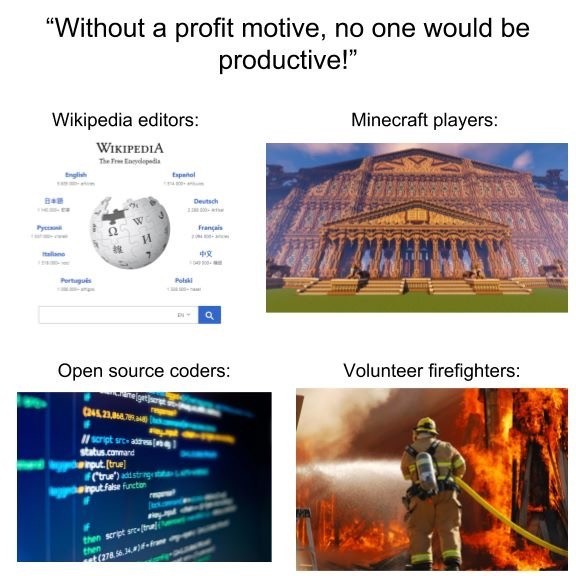
If something really needs to get done, like repairing necessary sewer systems, then it will get done, because it needs to. Do you really think that people who have the skills to repair the water treatment plant are going to just deal with sewage backing up into their home because they don’t want to do the work?
For a more comprehensive analysis of the question, I’d direct your attention towards an anarchist FAQ. I’ll quote a few choice sections below, but the link goes into great detail, comparing and contrasting multiple approaches to handling the problem.
I can agree to that as long as it’s a spelled-out condition of living in that community. As an autistic person myself, I like having expectations and conditions written out clearly and concisely, in mutually agreed-upon language.
It absolutely would be, yes. Anarchist communes function based on codified agreements, reached through direct democratic processes and consensus decision making. You would not only have all of the expectations of the society written out, you’d also have full and equal input into what those rules are, so we can guide the structure of society towards one that works for everyone.
For more information, you could check out the section “What could the social structure of anarchy look like?” in an anarchist FAQ.