

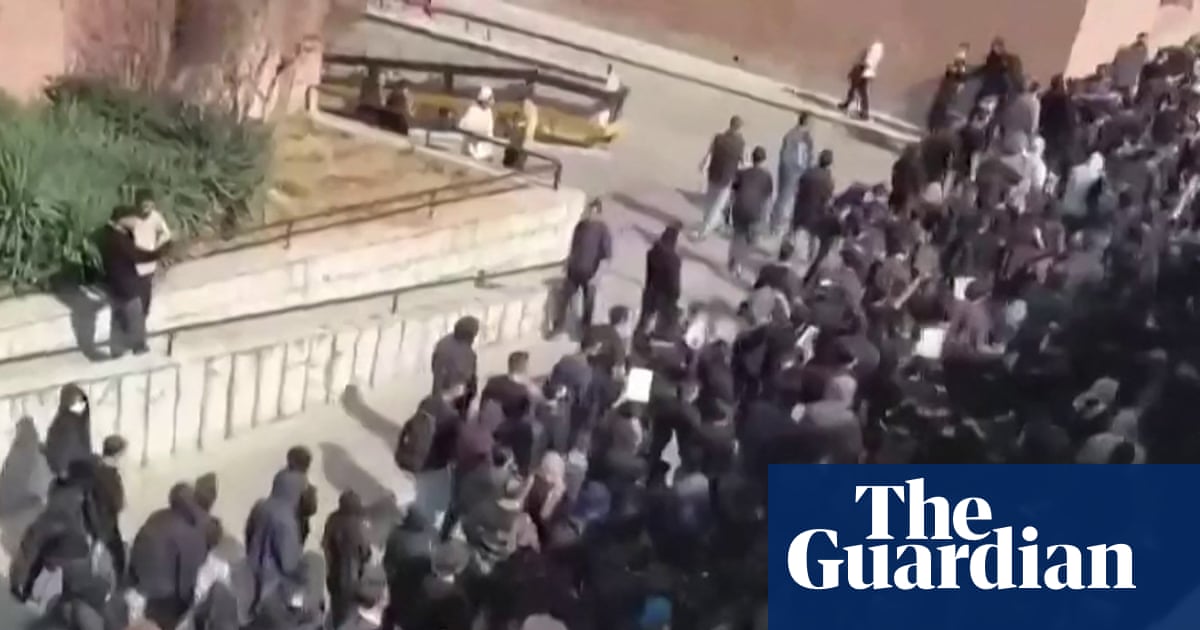
As details of the death toll for January’s protests continue to emerge, three students explain why they are resisting a return to normality
More than 45 days after a brutal January crackdown that left thousands of Iranian protesters dead, students across several universities are protesting again. As Iran’s new academic term began on Saturday, students in Tehran gathered on campus, chanting anti-government slogans, despite a heavy security presence and plainclothes officers stationed outside university gates.
The Guardian spoke to protesting students about why they were rallying despite the fact that thousands had been killed and tens of thousands arrested in the January demonstrations.
“Our classrooms are empty because the graveyards are full,” said Hossein*, 21, a student at the University of Tehran. “It’s for them – our friends, classmates and compatriots, who were gunned down in front of our eyes, that we decided to boycott the classes.”
Will you accept evidence? Or will you downvote and call me a Russian bot?
https://www.theguardian.com/news/2003/jan/26/letters.iraq1
That’s a classic consent-making move: the debate becomes when invasion is justified, not whether the West has the right to invade at all.
“the government argued its actions ‘undoubtedly’ saved civilian lives in Libya.” “required decisive and collective international action”
https://www.theguardian.com/world/2016/nov/25/british-government-intervention-libya-saved-lives
Even when the article notes criticism, this kind of repetition of official justification is exactly what sourcing/agenda-setting critiques focus on.
A no-fly zone is an act of war (you enforce it with force). But it’s often discussed as a humanitarian “measure.” The Guardian’s reporting frames it that way:
“a potential no-fly zone over Syria to protect civilians”
https://www.theguardian.com/world/2016/oct/12/may-questions-syria-no-fly-zone-proposal
And then the debate becomes technocratic (“who enforces it?”) rather than moral/anti-imperial (“who gets to control Syrian airspace?”). Example of that framing inside the piece: “Who would enforce that safe area?”
“All sides should contribute to halting the cycle of violence”
https://www.theguardian.com/commentisfree/2014/jul/13/guardian-view-conflict-in-gaza
Same editorial also uses the legitimacy gateway line: “Israel has a right to defend itself”
And frames it in a way to not directly endorse it, but still assert it by not stating the objectively moral rebuttal: Gaza has the right to defend itself.
Here they outright assert it: “Israel has a right to defend itself and a duty to protect its citizens.” https://www.theguardian.com/commentisfree/2023/nov/13/the-guardian-view-on-gazas-casualties-mounting-calls-for-a-ceasefire-must-be-heeded
This is a very strong legitimising phrasing because it implies the violence is mainly a matter of proper execution rather than structural injustice / siege / occupation: “Israel has a right to defend itself by all legitimate means.” https://www.theguardian.com/commentisfree/2024/apr/07/observer-view-only-ceasefire-save-israel-from-crisis
This is exactly the kind of moral language that can slide into collective punishment logic (even if the editorial later adds caveats): “Hamas had to be punished severely and forcibly dislodged from its perch in Gaza.” https://www.theguardian.com/commentisfree/2024/oct/06/the-observer-view-on-the-middle-east-a-year-on-there-is-only-one-way-to-a-credible-peace
This rhetorical move invites readers to inhabit the state’s mindset. another common consent mechanism: “Confronted by all this, Israelis ask, reasonably enough: what would you do?” https://www.theguardian.com/commentisfree/2024/oct/06/the-observer-view-on-the-middle-east-a-year-on-there-is-only-one-way-to-a-credible-peace
Not genocide, guardian. You shouldn’t do genocide.
Even when labelled “alleged,” this piece foregrounds the IDF narrative and evidence drops in a way that can function as justification-for-bombing context:
“alleged evidence released by the IDF to support its claims that Hamas uses… Gaza as human shields” https://www.theguardian.com/world/2023/oct/30/human-shield-israel-claim-hamas-command-centre-under-hospital-palestinian-civilian-gaza-city
“Israel has cited what it says are numerous examples of Hamas using human shields” https://www.theguardian.com/world/2023/oct/30/human-shield-israel-claim-hamas-command-centre-under-hospital-palestinian-civilian-gaza-city
“It claims Hamas has placed… command network under… al-Shifa hospital.” https://www.theguardian.com/world/2023/oct/30/human-shield-israel-claim-hamas-command-centre-under-hospital-palestinian-civilian-gaza-city
you can believe Hamas uses civilian cover and still see how this repeated framing becomes a ready-made moral alibi for mass civilian killing. We know Israel uses Palestinians as human shields, they’ll literally strap children to the windshield of jeeps to shield them, why don’t they cite that as rebuttal? Why don’t they cite that as justification for attacking IDF?
On their funding: Guardian Media Group says it runs a “diverse revenue model” including “reader revenues, advertising… licensing and philanthropic funding.” https://www.theguardian.com/about/organisation
And it says “Revenue from readers now accounts for over 50%” which also means a large share is still non-reader money (ads, licensing, etc.)
Their own annual reporting stresses growth in reader revenue, but they’re still operating in the same media ecosystem: big audience incentives, elite access journalism, reliance on official sources, and the kinds of “respectable” foreign policy frames that dominate UK/US politics. (That’s exactly what “manufacturing consent” critiques are about: structures, not cartoon villain owners.)
Read Manufacturing Consent, then come back and tell me they don’t.
Or downvote and maybe throw an insult my way, that works too.
Really? You could not do it without weird and undounded assumptions? C’mon, grow up.
Anyway, I appriciate you provide actual reasoning for your arguments. I’ll read into it.
It’s what happens every time. I’m sorry, that was unnecessary, I felt burnt out.