People be writing words with the letters all connected in cursive so the quill didn’t have to lift up or whatever.
How come they didn’t do that with the digits in numbers?
You must log in or register to comment.
They do exist, though I dunno if you’d find any examples online
But they suck for most uses because there aren’t number words.
Like, in print or cursive, the word “pool” exists as a distinct combination of letters that can be recognized even with sloppy writing. I’m using that as an example because I’m dyslexic and that’s one of my favorite examples of how I manage to read as fast or faster than someone that isn’t.
However, 1984, 1776, 2025, they don’t necessarily have the same “weight” in memory where you would recognize them if the numbers are connected.
And with math connected numbers would be a shit show from top to bottom.
So there’s really no use case for learning connected numbers. They aren’t useful, and cause problems. Why learn Cyrillic if you never run into books printed in it? Even that would be a more useful thing to teach in schools than connected numbers. There’s no good reason for connected numbers except for private notation. Even then, you’d not save much time unless you’re writing a shit ton of numbers, and you’d better be able to practice both doing them and reading them if you want those notes to be useful later.
Afaik, nobody uses them at all nowadays. For anything. So finding instructions on how to do it isn’t likely online (though I’m going to check just out of curiosity and edit in if I find it). It would be unlikely to find any of the old texts that teach it even in a decent book collection.
Couldn’t find any, but decided to do an example from memory

As you can see, even discounting my shitty skills in writing on screen, there’s some serious issues with reading connected numbers.
Uppercase letters in succession don’t work in cursive. And almost nobody uses lowercase numbers, even back then.
Finally an answer. Thank you.
Edit: wait a second… If lowercase numbers did connect, and were once used, why not any more?
I can’t find any results for “connecting cursive numbers” or “joining cursive numbers”.
lowercase numbers
fucken gottem by accident lol
How are deez nuts relevant in this context?
Traditionally numbers in text should be written out fully, so “three hundred and twenty seven” instead of “327”
Also western Arabic numerals are relatively new to English, before we used Roman numerals, which are all upper case.
In typesetting, numbers ten and under are always spelled out, and also numbers at the start of a sentence of any size. Numbers one, through ninety-nine are hyphenated if spelled out, ninety-nine percent of typesetters agree. Also, the “and” is frowned upon. It should be “three hundred and twenty-seven”, if quoting, if that is what was said, but three hundred twenty-seven otherwise.
However, numerals in text is fine, outside of the limitations above, and there are lowercase numerals in many classic typefaces that are less jarring to the eye in body type than the uppercase numerals.

Consider the number, 1,234,567. Spelled out, it’s one million two hundred thirty-four thousand five hundred sixty-seven. That’s cumbersome. That would almost always be written with numerals, and not spelled out. And, a sentence including it should be written to keep it from the beginning.
(Yes, children, I said sixty-seven, please try to contain yourselves.)
In a legal setting even those long numbers are still spelled out in contracts in many jurisdictions.
Ludicrous!
Although they did get spelled out on checks in the old days as a anti-fraud counter measure.
They still get spelled out on checks today.
There are still checks today?
Yes, I will be writing one to pay my rent later today.
Whoa
We still have a couple of fairly large companies that pay us by check. I hate it because our finance office requires that it be deposited immediately and it disrupts my day.
Which is weird, because since ~2006 all checks are treated the same as debit card transactions after the first check is processed, since both sides now have full routing info.
It’s important to spell out numbers in addition to writing them when it comes to important documents and such
It helps you verify the numbers are accurate
In the old days? I still do it. Just not that often.
but three hundred twenty-seven otherwise
Depends on the dialect. That “and” is a requirement in British English.
Because seven ate nine.
The “and” is necessary in British English at least (saying that the US constitution uses it)
(In older forms it would be three hundred and seven and twenty)
The meme isn’t sixty seven, pops.
… You apparently haven’t been around the kids who push this annoying meme? They absolutely would count “sixty seven” as “six seven” without a split second of thought.
It’s not hard rules, though. There’s a myriad of publishing styles. Each define different rules and guidelines to when and where numbers are spelled out. Hyphen was dropped from several guides, for example. The and has also been optional for certain publishing houses for a while, but in England it is still mandatory. Academic and literary will differ in how they enforce this guides and exactly what they are. Language is relative, changing and fluid, and this was all different mere 30 years ago. It moves with the expectations of the audience.
Also, it is six seven. Respect the memes guidelines.
I thought that was only for single digit numbers. Or is that a more recent convention?
I don’t know how universal it was, but in old documents it’s common to see dates written out fully in the form of “on the thirty-first day of January in the year of our lord two thousand and twenty-six”
First off, only a subset of cursive systems connect all letters. These are called Continuous Cursive. Second, many cursive writing systems do include numbers.
Huh, I thought the only point of cursive was to connect the letters.
I searched online for cursive connected numbers, but I couldn’t find any.
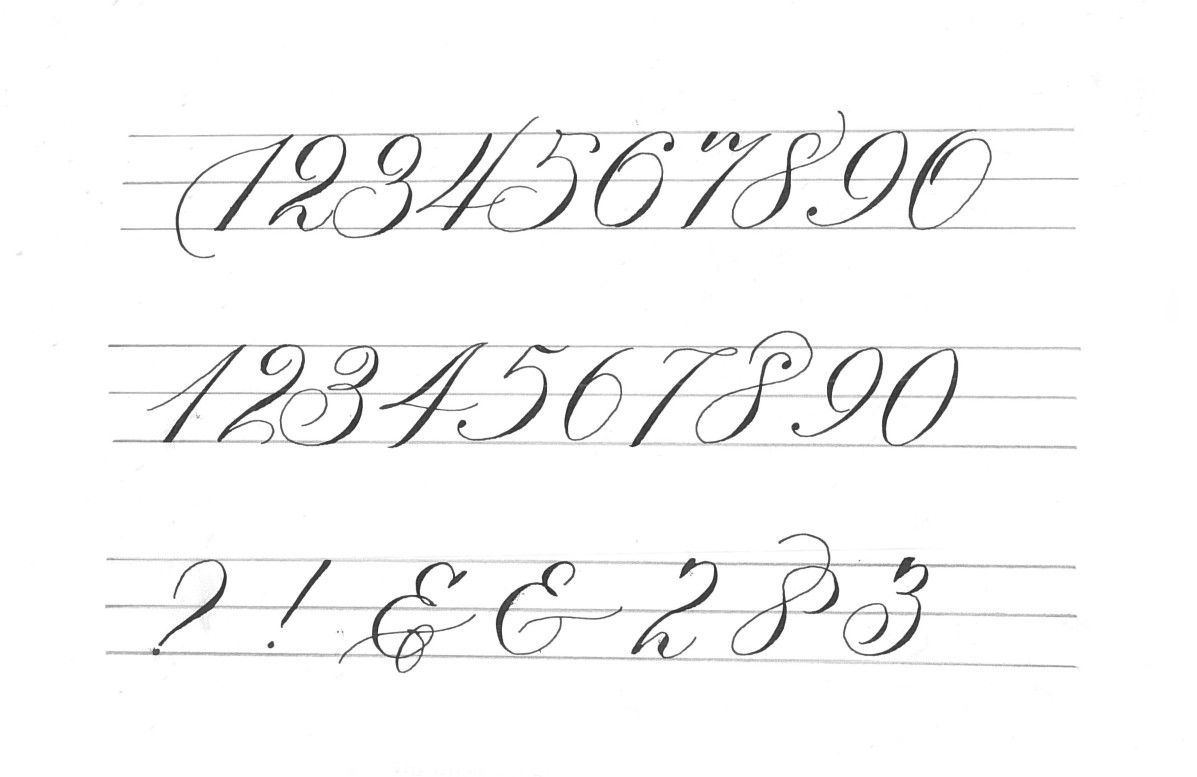
They are not connected to each other, they’re just fancy. That’s not cursive.
0/3 of these are connected.

The two and zero aren’t connected in this either. I am coming to accept that numbers are not connected in cursive. And elsewhere in the thread, it is said that this is done for clarity. So thank you, Mr. Snark, for your contribution. Even if you did not intend to contribute and just wanted to dunk on me.
00 on cheques . That normally has a line connecting at the top, that’s the only one I can think of.
Just tried it and it looks crap - I can’t imagine how to write “321” clearly in cursive, for instance. I think that’s why.
Roman numerals kind of work in cursive (sometimes i to x are written in lowercase, e,g in document indexes) so maybe it’s all downstream of our numbers actually originating from arabic calligraphy?
Follow-up: I think people historically, and today, want numbers to take up not much space - historically so they fit in ledgers, but also because calculations take up so much space on paper so small numbers helps.
When people were doing bookkeeping they generally work slow and carefully, and can therefore afford to focus on legibility rather than resorting to cursive.
Cursive just opens up more potential for mistakes - misreading your own working, for instance.
I’d imagine that whereas you can guess at confusing cursive letters in words from the others around them, you can’t do that with digits.
We learned numbers in cursive class
Who said they don’t include numbers
Me. I couldn’t find any examples when I searched.
I thought I remembered cursive numbers too.
Why did you think there aren’t cursive numbers?
No evidence of any existing.
Just Google image cursive numbers
Not all of them are dramatically stylish but neither are all letters.
a cursive e can look mostly like a regular e too depending on the style
They are not connected.
Someone elsewhere in the thread wrote that numbers are considered capital letters in cursive and capital letters don’t connect. So I guess that’s why.
Yeah I think it’s a clarity thing. Numbers are often going to be the most important parts of the document (price, date, identification) and they need to be clear and differentiable from the other text.
Also older cursive was much more flamboyant than what we learned a few decades ago. Only calligraphic numbers will still look fancy, cursive writing will just slant the number and also you learn to write them perfectly consistently
Modern cursive is almost entirely just normal letters modified to have connectors (and being slanted) but there are a few weird letters like r, s, f, z which wouldn’t be connectable written normally.
So we’ve definitely been shifting to everything looking standardized anyway.

I’ve been thinking about it a bit and I think it would be pretty easy to connect multiple zeros at the top, and maybe a few other numbers, but that explanation makes sense as for why numbers were not connected usually.