

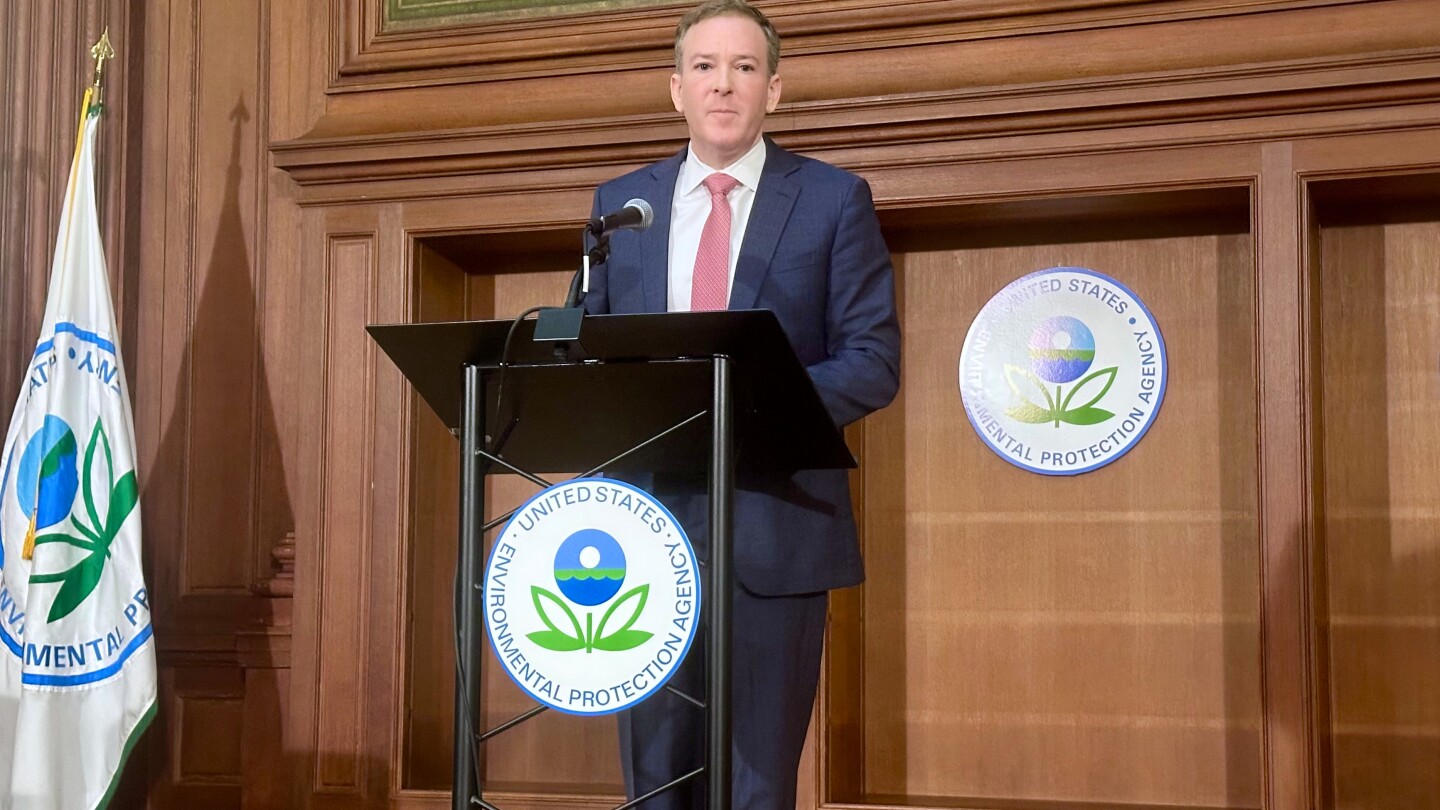
The Environmental Protection Agency has removed any mention of fossil fuels — the main driver of global warming — from its popular online page explaining the causes of climate change. Now it only mentions natural phenomena, even though scientists calculate that nearly all of the warming is due to human activity.
Sometime in the past few days or weeks, EPA altered some but not all of its climate change webpages, de-emphasizing and even deleting references to the burning of coal, oil and natural gas, which scientists say is the overwhelming cause of climate change. The website’s causes of climate page mentions changes in Earth’s orbit, solar activity, Earth’s reflectivity, volcanoes and natural carbon dioxide changes, but not the burning of fossil fuels. Seven scientists and three former EPA officials tell The Associated Press that this is misleading and harmful.
“Now it is completely wrong,” said University of California climate scientist Daniel Swain, who also noted that impacts, risks and indicators of climate change on the EPA site are now broken links. “This was a tool that I know for a fact that a lot of educators used and a lot of people. It was actually one of the best designed easy access climate change information websites for the U.S.”
From my perspective, the climate issue is not easy to fix but it is easy to understand.
The planet closest to the sun is Mercury. On Mercury a day is equivalent to 88 days on Earth. In sunlight Mercury can be as hot as 420 °C (790 °F). In darkness Mercury can be as low as −170 °C (−270 °F). The reason for the difference is that Mercury has no atmosphere and is unable to retain heat.
Now lets look at Venus. A day on Venus is 116.75 Earth days. The daytime and nighttime temperatures on Venus are nearly identical and have an average of 464 °C (867 °F). Venus has a very dense atmosphere that is mainly composed of carbon dioxide (96.5%) with the remainder being mostly nitrogen.
The sun may be the source of the heat, but the reason it stays warmer or colder on our planet is directly related to how much carbon dioxide is present in the atmosphere. Increasing carbon dioxide makes us warmer and decreasing carbon dioxide makes us cooler. There are other factors, but those are the basics.
The only practical control we have on carbon dioxide in our atmosphere is controlling and moderating our use of fossil fuel.
It really is that simple.
great way of seeing it! I think it like this: Almost all the energy that the earth has received had come from the sun, a bit from its core temperature, a bit from its rotation, a bit from moon’s rotation and a bit from impacting objects. This solar energy was stored by living organisms as lower entropy organic matter through almost 4 bn years, reducing the amount of heating to the earth by using that energy in a controlled manner. All that “stored heat” is now being released in a span of centuries, and the cherry on top: producing green house gasses.