

- cross-posted to:
- foss@beehaw.org
- cross-posted to:
- foss@beehaw.org
You must log in or register to comment.
look at what they need to mimic a fraction of our power
I’d prefer to strip things out myself.
No telemetry, no AI, no store, disable about 30 unnecessary services. I can make Win11 run ~110 processes (down from ~160) and idle at about 2GB RAM vs 6+. It takes about 30 minutes to so so on a fresh install, but it’s worth doing if I absolutely need windows.
Same as I do, the main issue in Windows is a ton of crap and some innecessary telemetries which it has by default. But as said, you can gut it. Installing Portmaster and using it in peace
The main issue in Windows is that it’s proprietary, no amount of patches/mods/wrappers/configuration scripts will change this
Yes, but a lot of people need to use Windows for several reasons and because of this to alleviate the disadvantages of an proprietary soft.
Do you run your own commands or use a program? I recently started using Windows Shut Up! and Winhance and that appears to be a good one two combo for mostly stripping bloat and blocking telemetry.
Just do it manually. I’ve done it enough it’s second nature anymore. CLI takes too much time to remember the scripts or exact verbiage.
Otherwise, I used to is the windows ultimate tweak tool from windows 7 era, it’s updated to Win11. I recommend that for friends and family remotely when I can’t help or connect in.
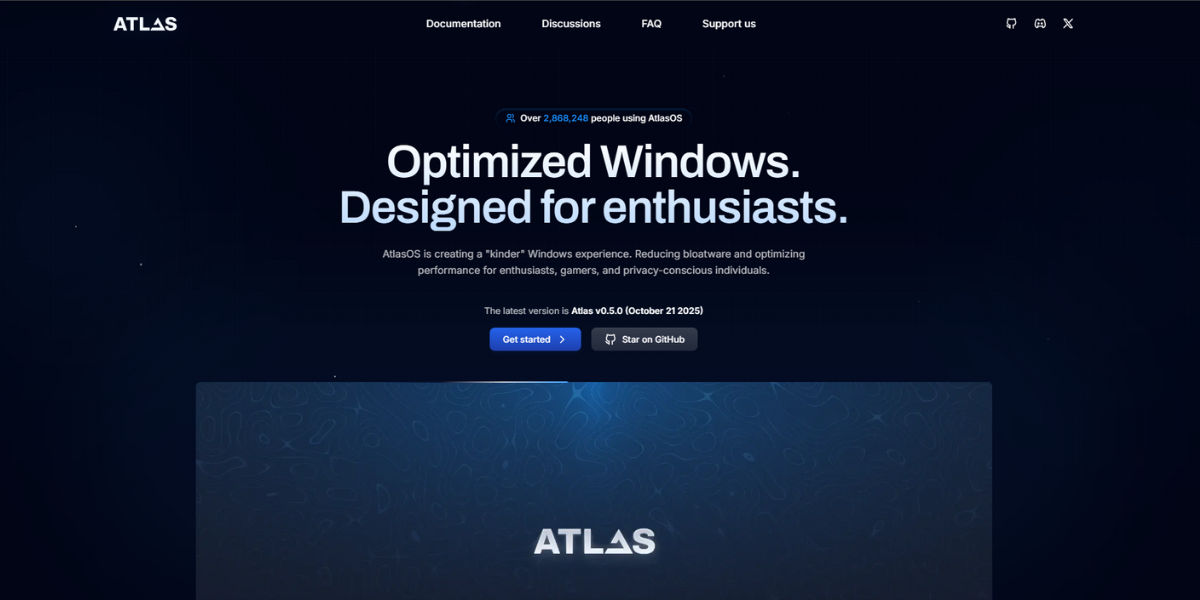
Unlike custom Windows ISOs, Atlas is more straightforward to audit due to the use of AME Wizard. AME Wizard is controlled by Playbooks, a customizable script-esque system that can perform various tasks.
Playbooks are renamed .zip archives, with the password malte. As they primarily consist of plain text, Playbooks enable transparency, unlike custom Windows ISOs, which have many entry points for malicious activity.
The few binaries in the Playbook are open source in our utilities repository, with the hashes listed here.
Although the GUI is not open source for AME Wizard, AME Wizard’s entire backend (called TrustedUninstaller) is open source under MIT, which contains each action used to run Atlas. The Atlas Playbook is open source under the GPLv3 license.
Impressive, they managed to find a decent OS under all that garbage?
I’m happy running Linux, but I think there are three possible outcomes for Atlas:
- Microsoft’s legal department is going to come down on the project with the full legal weight of copyright laws, and tie developers’ efforts and energy up in red tape.
- Microsoft will just quietly build obstacles into Windows updates that makes Atlas maintenance next to impossible, or just hard enough to wear developers out.
- Atlas will just putter out on its own due to lack of interest, because users are either too complacent to abandon Windows or already eyeing more established alternatives like Mac or Linux.
It’s few Microsoft can do legally, there is no change in the OS as such, you need a valid and legal Windows installation to use AtlasOS, they can’t avoid the user choice using other services and tools instead of the inbuild ones, in updates there are only important security updates, which are not a problem if you continuo using the Defender (recomendable). Atlas exist since ~10 Years, also there isn’t a problem with it, same as with the apps to debloat Windows, which also exist since a lot of years. Windows as such is a decent OS, it’s same as others based on Unix. It’s bad because the garbadge, telemetries, AIs and “Services to improve the user experience” in it by default. It’s the same as with stock Android respect de-googled Android and forks, it’s not Android which is bad (it’s in essence Linux), it’s all the crap Google put in it.
Not opensource
Edit: Apologies for my comment. I meant to say that it still doesn’t change the fact that Windows is not opensource.

Unlike custom Windows ISOs, Atlas is more straightforward to audit due to the use of AME Wizard. AME Wizard is controlled by Playbooks, a customizable script-esque system that can perform various tasks.
Playbooks are renamed .zip archives, with the password
malte. As they primarily consist of plain text, Playbooks enable transparency, unlike custom Windows ISOs, which have many entry points for malicious activity.The few binaries in the Playbook are open source in our
utilitiesrepository, with the hashes listed here.Although the GUI is not open source for AME Wizard, AME Wizard’s entire backend (called TrustedUninstaller) is open source under MIT, which contains each action used to run Atlas. The Atlas Playbook is open source under the GPLv3 license.
Don’t do this, just run a Linux distro if you don’t run anything that’s vendor-locked to Windows by DRM.
I’m sceptical, what can you really do that Microsoft will allow
A lot, you can strip out almost everything in Windows to the level of the OS as such (as I’ve done since years, using the bare OS with only the needed, all other by third party FOSS). The problem in Windows is not this, but that MS calculates that the majority of users do not do it, because many things are undocumented and it is necessary to dive through countless menus and submenus to reach the corresponding configurations, often not very intuitive. This is why there are apps that take care of it. like ShutUp10, Optimizer and similar, or they directly intercept the corresponding layers on the OS like this AtlasOS… But all this can also be done manually without problems, but with the condition that you know well what you are doing, nothing for beginners. Even so, always with a lot of caution.