

All jokes aside, this is super exciting if you are interested in instrumentation for environmental monitoring.
All I’m hearing is “tricorder on the way”
As someone watching their diet right now: finally, accurate macro tracking. At least if they manage to do some sort of sensor fusion with the camera.
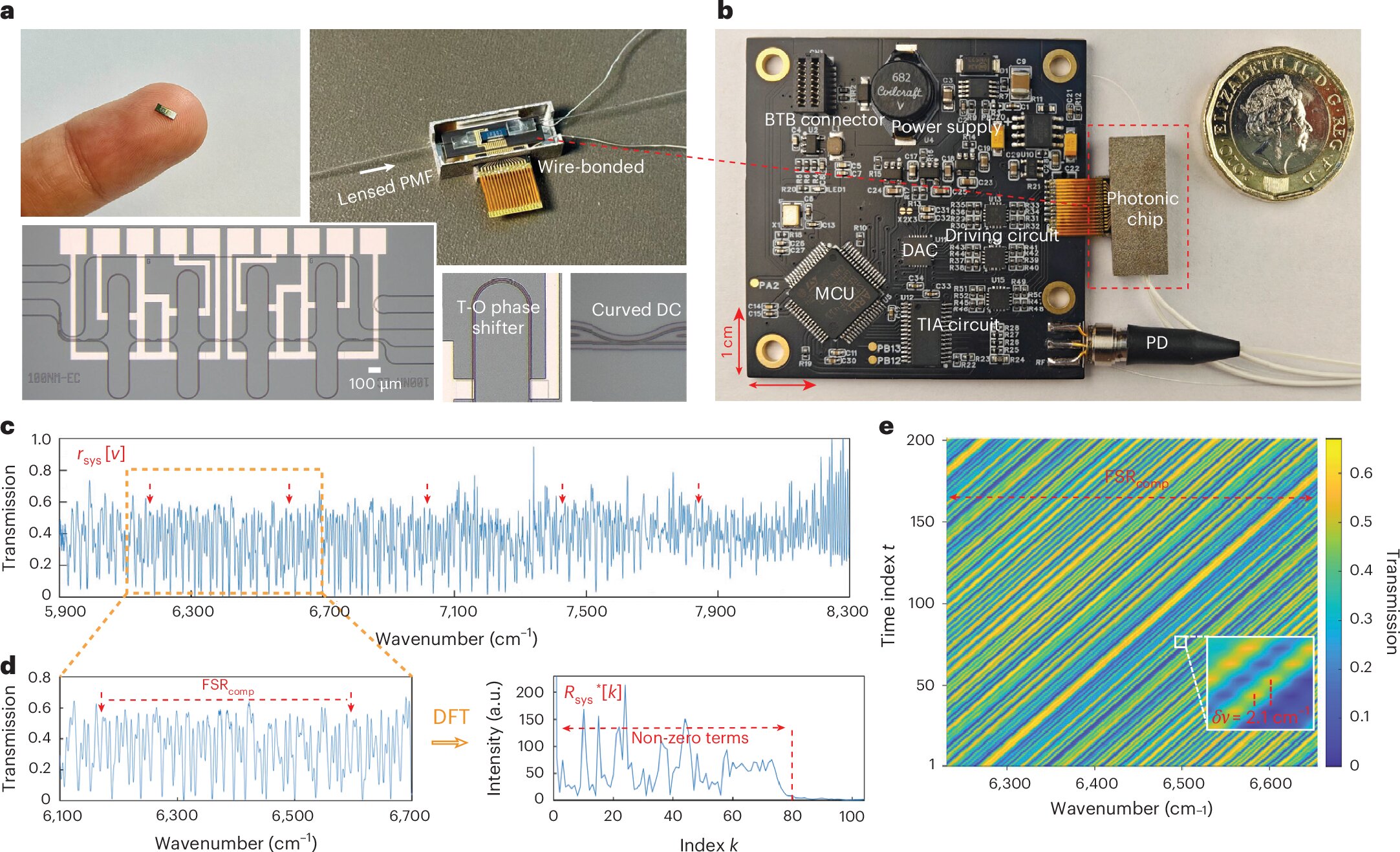
Unlike conventional spectrometers, which rely on dispersing light or algorithmic reconstruction to recover spectra, the convolutional spectrometer physically performs a convolution operation on the incoming light. This is achieved using a simple cascade of optical components with periodic spectral responses, such as unbalanced Mach–Zehnder interferometers or micro-ring resonators.
Is this thing a spectrometer or a fucking turbo encabulator?
I’ve worked with spectrometers and on spectrometry design before, and that quote from the article is intelligible. It’s also pretentious and poorly explained.
I’ve never worked with spectrometers but physics and chemistry were some of my strongest subjects, so it made some sense to me - but the sentence was definitely written with the intent to say “look peons, I know big science words you do not, and I can string them into a sentence you’ll question the legibility of”.
So, not bullshit?
Not bullshit. Just another poorly written popsci article promoting real research.
I literally went onto the comments to post this exact comment about that exact paragraph. Love to see another enjoyer of side fumble prevention.
Dat malleable logarithmic casing doe.
such as unbalanced Mach–Zehnder interferometers or micro-ring resonators
It has a base-plate of prefamulated amulite surmounted by a malleable logarithmic casing, aligned in such a way that the 2 main spurving bearings are in-line with the pentameter fan.
The spectrometer knows where it is, because it knows where it isn’t.
The chemical sensors on my smart watching begging me to stop dipping my hand into the unknown chemical bucket at work.
Tapping my Apple Watch to the mirror someone graciously passed me to test the blow for fent
The writing in the linked article is a little weird, as others have pointed out. However the journal publication is very cool. If this is reproducible, it’ll likely have a noticeable impact over the next 10 years or so. We won’t see $10 spectrometers, but we might see handheld ones in a similar format to the cheap IR cameras.
Here’s the link for anyone interested.
If you’re familiar with this kind of stuff, do you think this could lead to cheaper and smaller hyperspectral cameras?
This technology isn’t for generating images but for measuring what frequencies are present in light.
I’m not 100% sure on the specifics, but it sounds like they are using some mathematical properties of fourier transformations to either broaden the frequency response of sensors or simplify the math required to get the final result.
Hyperspectral cameras are designed to generate images from a matrix of light sensors.
This could maybe lead to spectral cameras (as in a camera where each pixel is the spectrum of light in that pixel), which could then generate images of arbitrary spectra, but I suspect that this sensor is still quite a bit larger than the sensors used in digital cameras these days. Even a hyperspectral camera doesn’t really care about what frequencies it measures, it’s just able to detect differences in amplitude at those frequencies and either doesn’t detect outside of that range or has something filtering the light outside of the range before it reaches the sensors.
From skimming, it sounds like they’re trying to use compressive sensing techniques, but push the “compute” to a physical, optical structure. That gives you a smaller device without the expensive compute (or the concern about losing data from random noise).
In general, it’s not hard to make a basic optical spectrometer. Most people have seen a prism splitting light into a rainbow. Imagine that plus an array of light sensing pixels. The light intensity on the array is your spectrum reading. The further away you put your pixel array, the more spread apart the colors in your rainbow, but the less light hits each individual pixel.
Optical spectrometers generally use diffraction gratings instead of prisms, but the trade-offs are the same. Longer optical path -> more spectral resolution -> more expensive light sensors.
Compressive sensing tries to break that trade-off by using math from information theory to get a usable data from fewer measurements. The single pixel camera is a great intro to the field. You use a single photodiode plus a series of known masks to take a series of measurements. From the masks + single pixel measurements, you can reconstruct the original image. There’s probably code out there to do it virtually if anyone’s interested. IIRC, to do a virtual measurement, you apply the mask to your image, then sum up the values. The reconstruction process is then identical to if you had real measurements.
For the $10 spectrometer, it sounds like they’re pushing some of that “compute” to a tunable optical system. In other words, the device “takes compressive sensing measurements,” but it does some of the reconstruction before it hits the light sensor.
One step closer to having tricorders hopefully, probably bullshit though.
In this timeline? More like citizen rationing spy devices.
I guess spectral recognition is cheaper and more accurate than image recognition now.
There you go, welcome for your new research area or business opportunity.
It’s the SCiO all over again
https://spectrum.ieee.org/angry-kickstarter-backers-ask-scio-wheres-my-pocketsized-molecular-sensor
I was so hyped for this thing …
Then I got it and well, I wasn’t impressedThought, this could lead to check chemicals on the go. Like checking if drugs are contaminated and things like that.
But it didn’t even got the basics to work…Well, was a lesson learned at least
Why am I not surprised that it’s an Israeli company?
Because it’s cheap?
Correct